Key Takeaways
- The Standardised Base Rate (SBR) is the benchmark Malaysian banks use to price new retail floating-rate loans and eligible refinancing.
- SBR moves directly with Bank Negara Malaysia’s Overnight Policy Rate (OPR).
- As of 5 November 2026, Malaysia’s SBR is 2.75% per annum.
- Your actual loan interest rate includes SBR plus a bank-specific spread, which varies between borrowers and lenders.
- A 0.25 percentage-point rate increase could add approximately RM58 to a RM400,000 mortgage’s monthly repayment over 30 years.
The Standardised Base Rate (SBR) is the common benchmark Malaysian banks use to price new retail floating-rate loans, including home loans. It also applies to refinancing and the renewal of eligible revolving retail floating-rate facilities. Introduced on 1 August 2022 by Bank Negara Malaysia (BNM), it provides a consistent reference rate across banks, making loan offers easier to understand and compare.
If you’re planning to buy a house or refinance your mortgage, understanding SBR can help you estimate monthly repayments and prepare for changes in borrowing costs.
However, SBR is not the actual interest rate you pay. Banks add their own pricing spread, and your repayments can change when BNM adjusts the Overnight Policy Rate.
This guide explains how SBR works in Malaysia, how it affects mortgage repayments, and how it compares with the older Base Rate (BR) and Base Lending Rate (BLR) systems.
Read More: Home Loan Approval Process in Malaysia: Step-by-Step
SBR in Malaysia at a Glance
| Component | Explanation |
| Full name | Standardised Base Rate (SBR) |
| Introduced | 1 August 2022 |
| Regulator | Bank Negara Malaysia (BNM) |
| Current SBR | 2.75% p.a. (November 2026) |
| Main application | New retail floating-rate loans and eligible refinancing |
| Rate calculation | SBR + Bank’s spread |
What Is SBR?
The Standardised Base Rate (SBR) is a common reference rate used by Malaysian financial institutions to calculate interest on floating-rate loans for individual borrowers.
It replaced the Base Rate (BR) framework for new retail floating-rate loans on 1 August 2022.
Before SBR was introduced, banks used different methods to calculate their respective Base Rates. This made comparing loan offers more complicated because each bank started with a different benchmark.
BNM introduced SBR to improve transparency and make the relationship between monetary policy and borrowing costs easier to understand.
How Is SBR Calculated?
The calculation is straightforward:
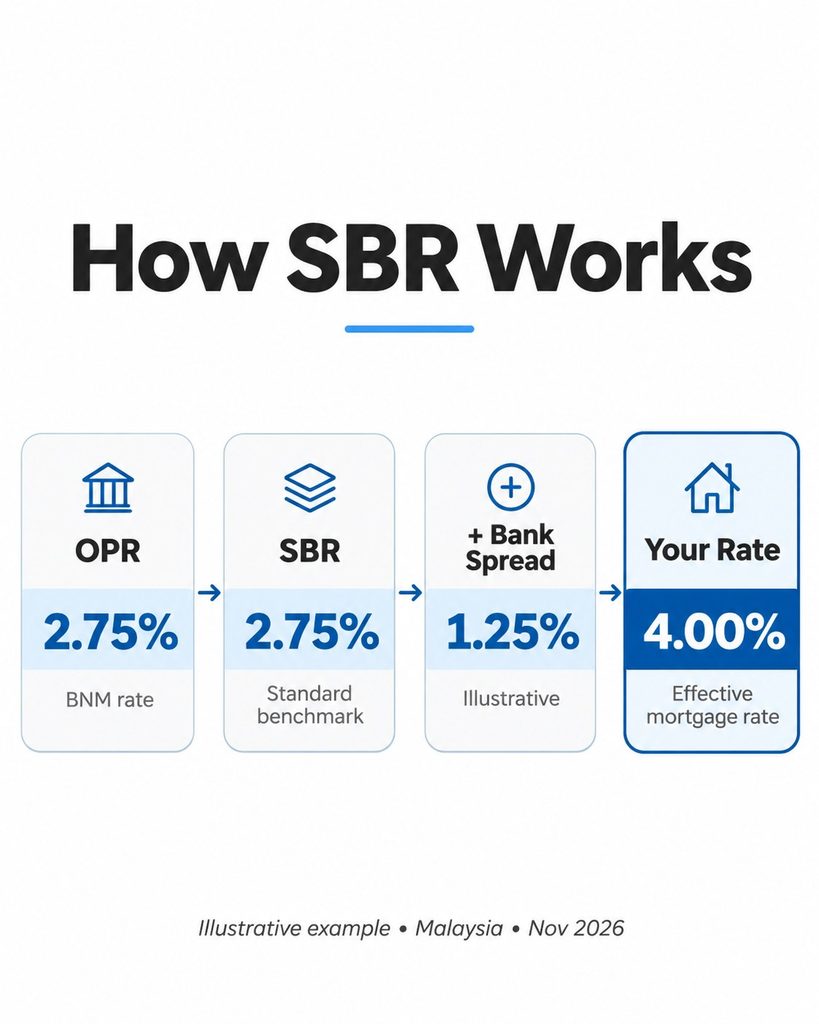
SBR = Overnight Policy Rate (OPR)
BNM’s Monetary Policy Committee determines the OPR, and SBR follows it directly.
For example:
- If the OPR is 2.75%, SBR is 2.75%.
- If the OPR increases to 3.00%, SBR increases to 3.00%.
- If the OPR decreases to 2.50%, SBR decreases to 2.50%.
Unlike the previous BR system, individual banks cannot independently determine their own SBR.
According to Bank Negara Malaysia’s Monetary Policy Statement, the OPR remained at 2.75% on 5 November 2026. Consequently, Malaysia’s SBR was also 2.75% as of that date.
How Do Banks Calculate Your Actual Loan Interest Rate?
Although SBR is standardised, the final interest rate offered by a bank can differ.
The formula is:
Effective Lending Rate = SBR + Bank’s Spread
The bank’s spread reflects several pricing factors, including:
- Borrower’s credit risk and repayment history
- Liquidity risk premium
- Operating costs
- Statutory Reserve Requirement (SRR) cost
- Bank’s profit margin
Consider two hypothetical mortgage offers using the same SBR.
| Component | Bank A | Bank B |
| SBR | 2.75% | 2.75% |
| Bank’s spread | 1.25% | 1.50% |
| Effective interest rate | 4.00% | 4.25% |
Despite having identical SBRs, Bank A offers a lower effective interest rate.
For a long-term housing loan, even a relatively small difference can affect the total interest paid.
When comparing mortgage offers, focus on the effective lending rate rather than SBR alone. Also review fees, lock-in periods and repayment flexibility to understand the overall cost.
Does SBR Apply to Every Loan in Malaysia?
No. SBR primarily applies to new retail floating-rate loans, eligible refinancing and renewals of revolving retail floating-rate facilities.
It does not automatically apply to:
- Fixed-rate loans with unchanged contractual interest rates
- Existing loans that remain linked to BR or BLR under their original terms, unless refinanced or otherwise changed to an SBR-linked arrangement
- Business financing outside the retail framework
- Financing products with other contractual pricing mechanisms
Islamic financing products can also use SBR as their reference benchmark, although their contractual structures may differ.
Before accepting an offer, check the product disclosure sheet to confirm whether the financing is linked to SBR.
How SBR Affects Repayments
Changes in SBR affect floating-rate loan repayments because an increase or decrease in the benchmark changes the interest rate applied to the outstanding loan balance.
When BNM raises the OPR, SBR increases by the same amount. This increases the interest rate on SBR-linked loans, assuming the contractual spread remains unchanged.
When the OPR falls, SBR decreases by the same amount. For SBR-linked loans with an unchanged spread, the applicable lending rate also falls. The effect on monthly repayments depends on the loan’s terms.
For borrowers, the most noticeable effect is a change in monthly instalments or, depending on the loan agreement, the repayment period.
Example: How Much Does an SBR Increase Affect a RM400,000 Mortgage?
Consider a Malaysian homeowner with the following hypothetical mortgage:
| Loan Detail | Amount |
| Outstanding loan balance | RM400,000 |
| Remaining tenure | 30 years |
| Initial SBR | 2.75% |
| Bank’s spread | 1.25% |
| Initial effective rate | 4.00% |
At an effective interest rate of 4.00%, the estimated monthly repayment is RM1,909.66.
Now suppose BNM increases the OPR by 0.25 percentage points.
SBR increases from 2.75% to 3.00%, raising the effective loan rate from 4.00% to 4.25%.
Monthly Mortgage Repayment Comparison
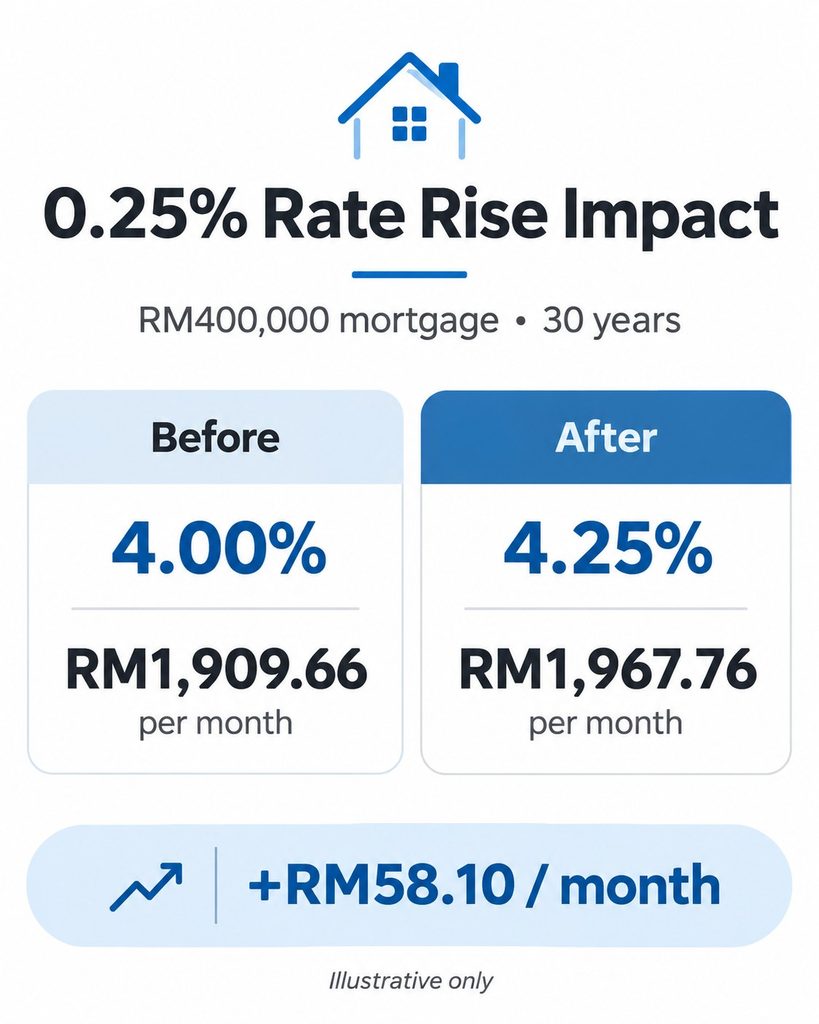
The homeowner would pay approximately RM58.10 more each month, assuming the outstanding balance and remaining tenure stay unchanged.
The calculation uses the standard reducing-balance mortgage repayment formula, with monthly interest calculated as the annual rate divided by 12.
These figures are illustrative. Actual repayments depend on the outstanding balance, repayment schedule and contractual terms.
What Happens If SBR Rises Further?
The table below compares several interest-rate scenarios for the same RM400,000 mortgage over 30 years.
| Effective Interest Rate | Monthly Repayment | Difference From 4.00% |
| 3.75% | RM1,852.46 | -RM57.20 |
| 4.00% | RM1,909.66 | Baseline |
| 4.25% | RM1,967.76 | +RM58.10 |
| 4.50% | RM2,026.74 | +RM117.08 |
| 5.00% | RM2,147.29 | +RM237.63 |
Note: These hypothetical calculations assume a constant interest rate for each scenario, a 30-year repayment period and no additional charges.
A borrower who can comfortably afford RM1,910 per month should consider whether repayments exceeding RM2,100 would remain manageable.
Will Your Monthly Instalment Change Immediately?
Not necessarily. According to BNM, revised instalments for existing floating-rate housing loans take effect within three months following an OPR adjustment.
The actual implementation depends on the lender’s notification and the loan’s repayment arrangements.
Some mortgages adjust monthly instalments, while others may extend the effective repayment period, subject to contractual terms.
Borrowers should review their bank’s notification to confirm the revised interest rate, repayment amount and effective date.
SBR vs. Historical BR/BLR
The main difference between SBR, BR and BLR is how Malaysian banks determine the reference rate used to price floating-rate loans.
Malaysia has used three major reference-rate frameworks for retail lending:
- Base Lending Rate (BLR), used before January 2015
- Base Rate (BR), introduced in January 2015
- Standardised Base Rate (SBR), introduced in August 2022
Comparison of SBR, BR and BLR
| Feature | BLR | BR | SBR |
| Main period | Before Jan 2015 | Jan 2015 to Jul 2022 | From Aug 2022 |
| Rate determined by | Individual banks | Individual banks | BNM’s OPR |
| Same across banks? | No | No | Yes |
| Main objective | Lending benchmark | Clearer pricing | Standardised comparison |
| Existing loans | May still apply | May still apply | Eligible newer loans |
How Did the Base Lending Rate (BLR) Work?
Under the BLR framework, banks published their own Base Lending Rates and commonly quoted mortgage pricing as a discount against BLR.
For example:
- Published BLR: 6.60%
- Loan pricing: BLR minus 2.60%
- Effective interest rate: 4.00%
Since banks could have different BLRs, comparing discounts alone could produce misleading conclusions.
How Was the Base Rate (BR) Different?
The Base Rate system separated the bank’s reference funding costs from other pricing components.
The effective rate was expressed as:
Effective Interest Rate = BR + Spread
Although this improved transparency, each bank still maintained its own BR.
Borrowers therefore needed to compare final effective interest rates rather than reference rates alone.
Why Is SBR Easier to Compare?
Under SBR, every bank starts with the same benchmark.
Consider two hypothetical offers:
| Component | Bank A | Bank B |
| SBR | 2.75% | 2.75% |
| Spread | 1.10% | 1.40% |
| Effective rate | 3.85% | 4.15% |
The difference comes from the spread rather than the underlying reference rate.
This allows borrowers to compare financing offers more directly.
However, a lower interest rate does not automatically mean a better mortgage. Lock-in periods, fees and repayment flexibility also affect the overall cost.
What Happens to Existing BR and BLR Loans?
Existing floating-rate loans linked to BR or BLR do not automatically convert to SBR.
Loans established before the SBR framework can continue using their original reference rates until maturity or full repayment, subject to their contractual arrangements.
Under Bank Negara Malaysia’s Revised Reference Rate Framework, historical BR and BLR benchmarks also move in tandem with SBR following OPR adjustments.
This means older floating-rate borrowers can still experience interest-rate changes.
Importantly, introducing SBR did not automatically reduce existing borrowers’ lending rates.
What Should You Check Before Accepting an SBR-Linked Loan?
Before signing a mortgage agreement, compare the effective interest rate, repayment flexibility, fees and contractual conditions.
SBR alone cannot tell you which mortgage is most suitable.
| What to Check | Why It Matters |
| Effective interest rate | Determines borrowing costs |
| Spread above SBR | Explains differences between offers |
| Lock-in period | May restrict early settlement |
| Flexi-loan features | Affect repayment flexibility |
| Fees and insurance | Increase overall financing costs |
Compare the Effective Interest Rate
Request the actual effective lending rate quoted in the financing offer.
Banks assess factors such as your creditworthiness, repayment history, income stability and existing financial commitments.
A competitive spread does not guarantee approval or a particular interest rate.
Understand the Lock-In Period
Some mortgages impose early settlement charges within a specified period.
If you plan to sell your property or refinance soon, these conditions can significantly affect your decision.
Check the duration, applicable charges and circumstances under which penalties are waived.
Review Flexi-Loan Features
Flexi and semi-flexi mortgages may allow borrowers to make additional payments towards their outstanding loan balances.
Depending on the product, this can help reduce interest costs or provide access to excess funds.
However, withdrawal conditions and associated fees vary between lenders.
Test Your Repayment Affordability
Before accepting a mortgage, calculate repayments under multiple interest-rate scenarios.
For example, consider whether your household budget could accommodate an effective interest rate that is 0.50 or 1.00 percentage point higher than the initial quotation.
This is a financial stress test, not a prediction of future OPR decisions.
Your mortgage should remain affordable even if borrowing costs increase.
Does a Lower SBR Mean It Is a Good Time to Take a Loan?
A lower SBR can reduce floating-rate borrowing costs, but it does not automatically make taking a loan financially sensible.
Interest rates are only one part of a mortgage decision.
When Taking a Loan Makes Financial Sense
A mortgage may be reasonable when you have:
- Stable income and manageable debt commitments
- Sufficient savings for the deposit and related expenses
- Repayments that remain affordable under higher-rate scenarios
- A property that meets your financial needs
When You Should Be More Cautious
Consider postponing your borrowing plans if:
- Repayments would consume most of your disposable income
- Your employment or business income is uncertain
- You lack emergency savings
- You depend on future interest-rate reductions to afford the loan
When Alternative Mortgage Arrangements Are Worth Comparing
Conventional bank mortgages are not the only property-backed financing arrangements available in Malaysia.
Depending on the borrower’s circumstances, refinancing or private mortgage solutions may be relevant.
However, private mortgages can have different pricing structures, charges, eligibility requirements and repayment conditions.
Do not assume private mortgage products are SBR-linked. Always verify the applicable interest rate, repayment structure and total borrowing costs before committing.
Understanding SBR Better
The Standardised Base Rate has made floating-rate mortgage pricing in Malaysia more transparent by linking the reference rate directly to BNM’s Overnight Policy Rate.
However, SBR is only the starting point. Your actual borrowing costs depend on the bank’s spread, financing terms and future interest-rate movements.
Before applying for a mortgage, compare effective lending rates, calculate repayments under different scenarios and review the conditions attached to each offer.
If you need guidance on property-backed financing, WH Asia provides mortgage consultant services in Malaysia, including private mortgage solutions for eligible property owners. Its mortgage consultants can help you evaluate suitable financing arrangements and understand the repayment terms before making a commitment.
Sources
- Bank Negara Malaysia (2021): Revised Reference Rate Framework, 11 August 2021.
- Bank Negara Malaysia (2026): Monetary Policy Statement, 5 November 2026.
- Bank Negara Malaysia: Monetary Stability and Overnight Policy Rate Guidance.
- Bank Negara Malaysia: Glossary of Financial Terms.
Frequently Asked Questions About Standardised Base Rate (SBR) in Malaysia
Is SBR the Same as OPR in Malaysia?
Yes. Malaysia’s Standardised Base Rate is directly linked to Bank Negara Malaysia’s Overnight Policy Rate. When BNM changes the OPR, SBR changes by the same amount.
What Is the Current SBR in Malaysia?
The current SBR is 2.75% per annum as of 5 November 2026. It reflects the OPR maintained by Bank Negara Malaysia at its latest Monetary Policy Committee meeting.
Can Banks Offer Different Interest Rates Despite Having the Same SBR?
Yes. All banks use the same SBR, but each lender determines its spread based on credit risk, liquidity costs and other pricing factors. Consequently, effective mortgage rates can differ.
Does SBR Affect Fixed-Rate Housing Loans?
No, not directly. A fixed-rate loan maintains its contractual interest rate during the applicable fixed-rate period. SBR changes affect floating-rate loans that use it as their reference benchmark.
Will My Mortgage Repayment Decrease If SBR Falls?
Not necessarily immediately. When SBR falls, the interest rate on an SBR-linked mortgage decreases if the spread stays unchanged. Depending on your loan agreement, this may reduce your monthly instalment or affect your repayment tenure. Check your bank’s notification for the revised amount and effective date.
Should I Refinance My Mortgage When SBR Drops?
Not automatically. Compare your existing effective interest rate with the proposed refinancing rate, including legal fees, valuation charges, early settlement penalties and other costs. Refinancing is worthwhile only when the overall benefits justify the expenses.