Key Takeaways
- Blacklisted applicants may still qualify for personal loans, depending on their credit history and repayment capacity.
- CCRIS and CTOS are credit reporting systems, not official loan blacklists.
- Clearing overdue debts and reducing commitments may improve approval chances.
- Licensed Kredit Komuniti providers offer alternatives, but borrowers must verify their licences and terms.
- Those struggling with debt should consider AKPK’s free financial counselling before borrowing more.
Blacklisted applicants in Malaysia may still qualify for personal loans. Having a poor CCRIS record, negative CTOS information or previous bank rejection does not automatically prevent you from applying again.
However, finding a willing lender is only half the challenge. The loan must also be affordable and legitimate.
Here’s how to understand your credit status, explore financing alternatives and improve your chances without falling into further debt.
Can You Get a Personal Loan While Blacklisted in Malaysia?
Yes, but approval is never guaranteed.
“Blacklisted” is an informal term commonly used to describe people with credit problems or rejected loan applications. It is not an official CCRIS classification.
Common situations include:
- Rejected bank loan applications.
- Late or missed repayments.
- Negative CTOS information or poor CCRIS records.
- Unpaid debts or legal proceedings.
- Bankruptcy restrictions.
These situations are not equivalent. A rejected application alone does not mean you have been blacklisted.
Bank Negara Malaysia (BNM) confirms that CCRIS is not a blacklist. It provides factual credit information, while lenders make their own lending decisions.
Why Do Banks Reject Personal Loans From Blacklisted Applicants?
Banks consider credit history, income, existing commitments and repayment capacity. Four common rejection reasons include:
1. Poor Repayment History
Missed payments on credit cards, car loans or personal loans may reduce lenders’ confidence in your repayment ability, especially when arrears remain unresolved.
2. High Debt Service Ratio (DSR)
Your Debt Service Ratio measures how much of your monthly income goes towards debt repayments.
DSR = (Monthly Debt Repayments ÷ Monthly Income) × 100
For example:
| Item | Amount |
| Monthly net income | RM4,000 |
| Existing monthly repayments | RM2,000 |
| Current DSR | 50% |
| Proposed loan instalment | RM500 |
| New total repayments | RM2,500 |
| New DSR | 62.5% |
A higher DSR may reduce approval chances because more income is committed to debt.
However, Malaysian lenders use different income calculations and affordability criteria. No universal DSR percentage guarantees approval.
3. Unstable or Insufficient Income
Applicants with irregular earnings, limited employment history or insufficient documentation may struggle to demonstrate repayment capacity.
This includes some freelancers, commission-based employees and self-employed individuals.
4. Unresolved Defaults or Legal Proceedings
Outstanding defaults and debt-related legal proceedings may concern lenders. A settled debt with documentation is different from an active default or unpaid court judgment.
How Can Blacklisted Applicants Apply for Personal Loans?
Follow these six steps before approaching another lender.
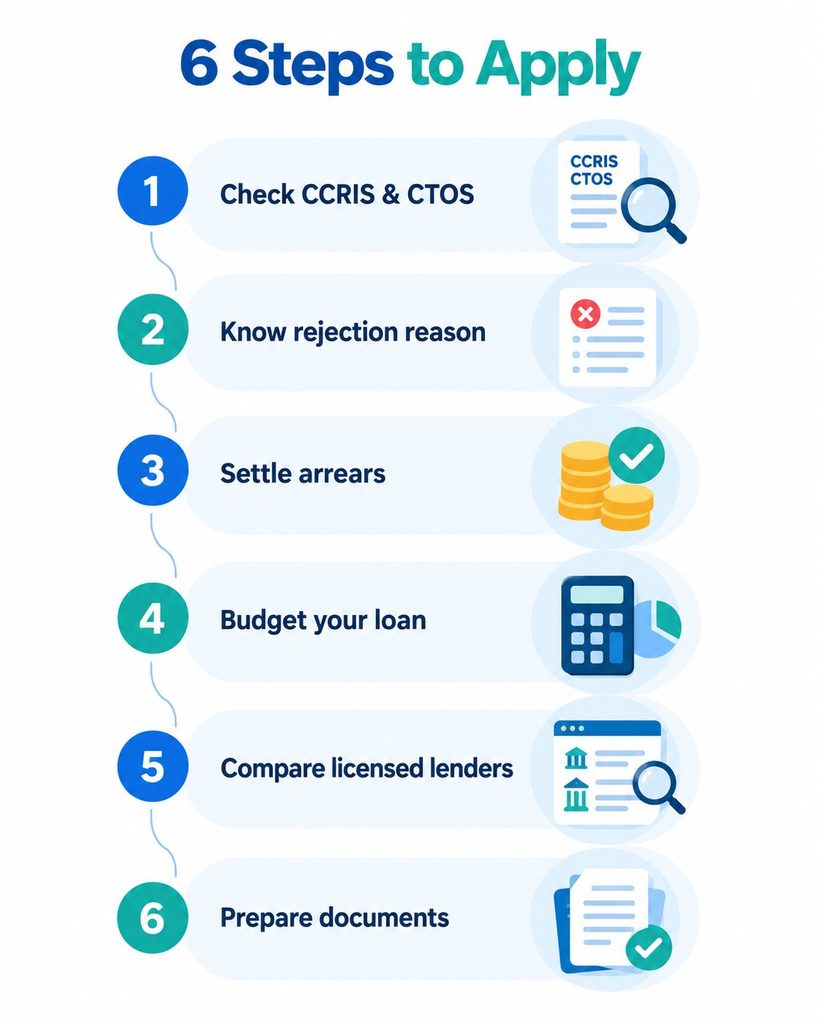
Step 1: Check Your CCRIS and CTOS Reports
Access your credit information through BNM’s eCCRIS portal and relevant credit reporting agencies.
Check:
- Outstanding loans and credit cards.
- Repayment history and overdue balances.
- Active credit facilities.
- Incorrect or outdated information.
CCRIS generally displays the preceding 12 months of repayment history. eCCRIS access is free, although private agencies may charge for certain reports.
Request corrections from the reporting financial institution or relevant agency if necessary.
Step 2: Identify Why Your Loan Was Rejected
Ask your previous lender about possible eligibility concerns, such as insufficient income, excessive commitments, missed payments or incomplete documents.
Addressing the underlying issue may improve future applications.
Step 3: Settle or Restructure Overdue Debts
Contact existing lenders about outstanding balances and repayment arrangements.
Prioritise arrears where possible and retain settlement letters. Settling a debt does not immediately erase repayment history or guarantee approval.
Step 4: Calculate Your Affordable Loan Amount
Review income, existing repayments, household expenses, family commitments and emergency needs.
Avoid borrowing if another instalment would leave insufficient money for essentials.
Step 5: Compare Legitimate Lenders
Compare financing rates, instalments, total repayment amounts and fees.
Verify each lender’s licensing status before sharing personal or financial information.
Step 6: Prepare Supporting Documents
| Document | Purpose |
| MyKad | Identity verification |
| Salary slips | Employment income |
| Bank statements | Income assessment |
| EPF statements | Employment information |
| Tax or business records | Self-employed income |
| Loan statements | Existing commitments |
| Settlement letters | Resolved debts |
Requirements vary by lender. Provide accurate information and disclose existing liabilities.
What Are the Legitimate Loan Alternatives for Blacklisted Applicants?
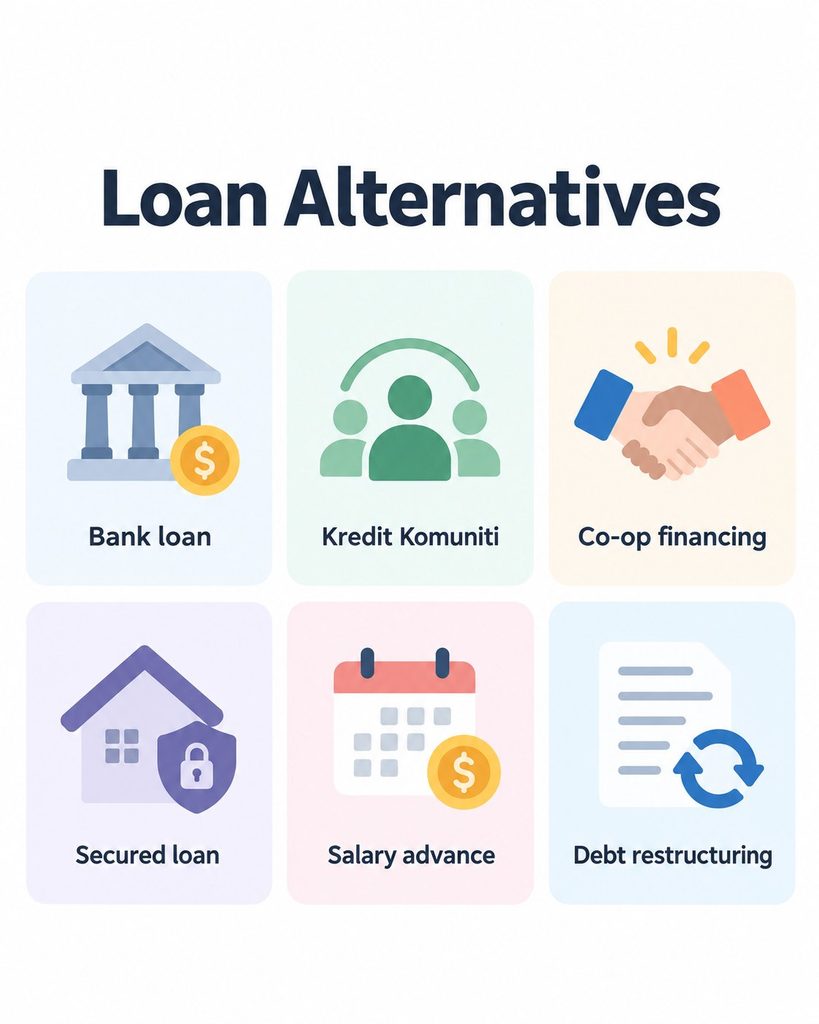
1. Bank Personal Loans
Banks may consider applicants whose previous credit problems have been resolved.
For example, someone who missed payments during unemployment but now earns a stable income may have stronger eligibility.
Approval remains subject to assessment.
2. Licensed Kredit Komuniti Providers
Licensed moneylenders, known as Kredit Komuniti providers, operate under Malaysia’s Moneylenders Act 1951.
Some may consider applicants with adverse credit histories.
According to the Ministry of Housing and Local Government (KPKT), statutory annual interest ceilings are:
| Loan Type | Maximum Annual Interest Rate |
| Secured | 12% |
| Unsecured | 18% |
These are legal ceilings, not guaranteed loan offers.
Verify the lender’s licence through KPKT’s official channels, including i-KrediKom for licensed providers in Peninsular Malaysia.
For online applications, confirm the lender has KPKT’s additional authorisation for online moneylending.
Review all charges and repayment terms before signing. Borrowers are entitled to a free copy of their loan agreement.
3. Cooperative Financing
Some cooperatives finance eligible members, including certain public-sector employees.
Check membership requirements, financing costs, salary deductions and repayment conditions. Approval is not automatic.
4. Secured Loans and Property-Backed Financing
Applicants with eligible property or other acceptable assets may explore secured financing.
Lenders may consider the security’s value alongside income, liabilities and credit history.
However, missed repayments could put the pledged property or asset at risk. Review valuation costs, legal fees and repayment obligations carefully.
How Much Could a Personal Loan Actually Cost?
The advertised rate does not reveal the full borrowing cost.
Consider a simplified RM10,000 loan over two years at 18% flat annual interest.
| Calculation | Amount |
| Principal | RM10,000 |
| Flat annual interest | 18% |
| Tenure | 2 years |
| Total interest | RM3,600 |
| Total repayment | RM13,600 |
| Monthly instalment | RM566.67 |
This illustration excludes additional charges and is not a lender quotation. An 18% flat rate differs from an 18% effective annual interest rate.
Actual calculations depend on the agreement and applicable regulations. Reducing-balance calculations may produce different results.
Request the full repayment schedule and total borrowing cost before accepting an offer. Longer tenures can lower monthly instalments while increasing overall interest expenses.
How Can You Improve Your Chances of Loan Approval?
Focus on five practical improvements:
- Clear overdue payments: Resolve arrears and retain settlement documentation.
- Reduce commitments: Pay down credit cards and other debts.
- Maintain income records: Organise salary slips, bank statements and business documents.
- Apply for a realistic amount: Borrow only what you can comfortably repay.
- Build repayment history: Make payments consistently and on time.
Avoid repeated applications without addressing previous rejection reasons. Where possible, enquire about eligibility before formally applying.
What If You Are Already Bankrupt?
Bankruptcy differs legally from having poor CCRIS or CTOS records.
Under Section 109(1)(m) of Malaysia’s Insolvency Act 1967, an undischarged bankrupt obtaining credit of RM1,000 or more must disclose their bankruptcy status to the credit provider before obtaining that credit.
Failure to disclose can constitute an offence.
Consult the Malaysia Department of Insolvency (MdI) officer handling your case before borrowing. Disclosure does not guarantee approval.
What If You Cannot Afford Another Loan?
Borrowing more when existing repayments already consume most of your income may worsen financial difficulties.
Malaysia’s Credit Counselling and Debt Management Agency (AKPK) offers free financial counselling and debt management assistance.
Consider AKPK if you:
- Regularly miss repayments.
- Borrow to settle existing instalments.
- Cannot manage monthly commitments.
- Struggle with essential household expenses.
Eligible borrowers may receive assistance with repayment arrangements involving participating financial institutions.
AKPK does not provide personal loans. Its role is to help borrowers manage debt more sustainably.
How Can Blacklisted Applicants Avoid Personal Loan Scams?
Be cautious of advertisements promising guaranteed approval without meaningful credit assessments.
| Warning Sign | Potential Risk |
| Guaranteed approval | Misleading or fraudulent claims |
| Upfront payments to release funds | Non-existent loan scam |
| Requests for OTPs or passwords | Account theft |
| Unverifiable licence | Unauthorised moneylending |
| Pressure to sign immediately | Hidden obligations |
| Transfers to personal accounts | Possible impersonation |
In a warning dated 6 December 2017, BNM highlighted fraudsters using fake moneylending licences and requesting advance payments for supposed administrative expenses, stamp duty or legal fees.
BNM does not issue moneylending licences. Kredit Komuniti lenders are regulated by KPKT.
Before applying:
- Verify the lender’s identity and licence.
- Read the complete agreement.
- Confirm charges and repayment terms.
- Never share passwords, PINs or OTPs.
- Avoid offers to erase legitimate negative credit information for a fee.
A bank rejection does not mean you must accept the first alternative loan offer.
Should You Apply Now or Improve Your Credit First?
Your next step depends on your financial circumstances.
| Situation | Recommended Action |
| Resolved late payment | Review credit reports |
| Outstanding arrears | Settle overdue debts |
| High commitments | Reduce or restructure debt |
| Stable income, bank rejection | Clarify rejection and compare options |
| Eligible property | Assess secured financing risks |
| Cannot afford repayments | Contact AKPK |
| Undischarged bankruptcy | Consult MdI |
There is no universal waiting period guaranteeing approval after rejection.
What matters is whether your current income, repayment history and commitments can support another loan.
Can Blacklisted Applicants Still Get Personal Loans?
Getting a personal loan while blacklisted in Malaysia may be possible, but approval depends on your credit history, income and repayment capacity.
Before applying, review your credit reports, address outstanding debts and compare legitimate financing options. Prioritise affordability over quick approval.
If you own property and are considering secured financing after a bank rejection, WH Asia provides alternative lending and mortgage solutions, subject to eligibility and financing assessment.
Our mortgage loan consultant services can help you explore property-backed financing options, costs and repayment commitments before deciding whether to proceed.
Always verify the relevant lending licence and review the full agreement before borrowing.
Disclaimer: This article provides general financial information, not personalised financial or legal advice. Loan approval and terms depend on lender assessment and applicable Malaysian laws. Verify the lender’s licence and review all terms before borrowing.
Frequently Asked Questions
Can I Get a Personal Loan With a Bad CCRIS Record?
Yes, but approval depends on your repayment history, debts, income and lender requirements. A poor CCRIS record does not automatically prohibit borrowing.
Can I Get a Personal Loan if My CTOS Score Is Low?
A low CTOS score may affect eligibility but does not guarantee rejection. Lenders also assess income, commitments and repayment capacity.
Can Blacklisted Applicants Get Personal Loans Without Salary Slips?
Some lenders accept bank statements, tax records or business documents as alternative income proof. Repayment capacity must still be demonstrated.
How Long Does It Take to Clear a Loan Blacklist?
There is no official CCRIS loan blacklist. CCRIS generally displays 12 months of repayment history, while other credit information follows different rules. Settling debts may improve your standing over time.
Can I Get a Personal Loan While Under AKPK?
Additional financing may be difficult during an AKPK debt management arrangement. Approval depends on lender policies and your financial circumstances. Consult AKPK first.
Is a Guaranteed Personal Loan for Blacklisted Applicants Legitimate?
Treat guaranteed approval claims cautiously. Verify the lender’s authorisation and avoid suspicious upfront payment requests.