Key Takeaways
- Debt consolidation refinancing combines multiple debts into one financing arrangement, making monthly repayments easier to manage.
- Refinancing may reduce borrowing costs if the new financing terms are more favourable.
- Homeowners may use eligible property equity to consolidate debts through mortgage refinancing.
- Lower monthly instalments do not always mean lower total borrowing costs.
- Compare financing rates, repayment tenure, fees and property risks before refinancing.
Debt consolidation refinancing can help simplify multiple debts, reduce monthly repayments and potentially lower borrowing costs. For eligible Malaysian homeowners, it may also provide a way to consolidate higher-interest debts through mortgage refinancing. However, the benefits depend on the new financing terms, repayment period and associated costs.
Managing multiple credit cards, personal loans and mortgage payments can become complicated, especially when each has a different due date and interest rate.
A debt consolidation refinance in Malaysia offers a way to reorganise these commitments into a more manageable repayment structure.
But does refinancing actually save money, or does it simply spread your debt over a longer period?
Here’s what you should know before deciding whether debt consolidation refinancing is suitable for you.
What Is Debt Consolidation?
Debt consolidation is the process of combining multiple outstanding debts into a single loan or financing arrangement.
Instead of making separate repayments to several lenders, you use a new financing facility to settle selected debts and repay the new facility according to its terms.
For example:
| Existing Debt | Outstanding Balance |
| Credit card A | RM15,000 |
| Credit card B | RM10,000 |
| Personal loan | RM35,000 |
| Total debt | RM60,000 |
With debt consolidation, these three commitments could potentially be combined into one RM60,000 financing arrangement, excluding additional fees.
What Is Debt Consolidation Refinancing?
Debt consolidation and refinancing are related but different.
- Debt consolidation: Combines several debts into one financing arrangement.
- Refinancing: Replaces existing financing with a new facility, potentially offering different rates, terms or repayment periods.
- Debt consolidation refinancing: Uses new financing to settle multiple existing debts.
In Malaysia, debt consolidation may involve personal financing, credit card balance transfers or property-backed refinancing.
For homeowners, cash-out mortgage refinancing is one option worth considering.
What Are the Benefits of Debt Consolidation Refinancing?
The main benefits include simpler repayments, potentially lower monthly commitments and opportunities to reduce overall financing costs.
However, each benefit depends on the terms offered by the lender.
1. Simplifies Multiple Monthly Repayments
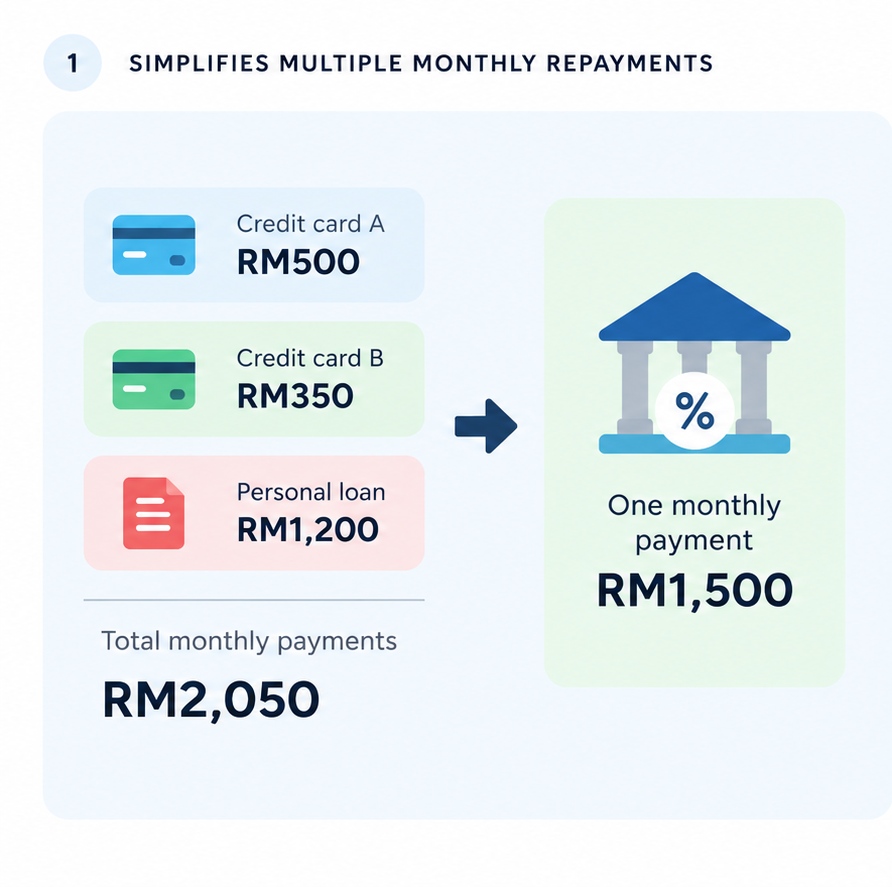
Managing several debts means keeping track of different payment dates, outstanding balances and interest charges.
Debt consolidation refinancing can simplify this process by bringing selected commitments into one repayment arrangement.
This may help you:
- Keep track of repayments more easily.
- Reduce the number of payment dates to remember.
- Organise your monthly household budget.
- Monitor your outstanding financing balance.
- Plan repayments more consistently.
For borrowers juggling several commitments, having fewer accounts to manage can make budgeting considerably easier.
However, debt consolidation does not eliminate the money owed. It simply changes how the debt is structured and repaid.
Read More: How to Refinance a Housing Loan Step-by-Step
2. May Reduce Your Monthly Repayments
One of the biggest reasons borrowers consider debt consolidation refinancing is to reduce their monthly financial commitments.
This may be possible through a lower financing rate, a longer repayment tenure or a combination of both.
For example:
| Monthly Commitment | Before | After |
| Total debt repayments | RM2,050 | RM1,500 |
| Monthly reduction | — | RM550 |
This is a hypothetical illustration, not an actual financing offer.
In this example, monthly debt repayments would fall by RM550, leaving more room in the household budget. However, the borrower should also consider any refinancing fees and whether a longer repayment period increases total borrowing costs.
The difference could help cover household expenses, build emergency savings or make additional debt repayments.
However, lower monthly instalments do not necessarily mean lower overall costs.
Extending the repayment period may increase the total interest or profit payable.
3. Could Lower Overall Borrowing Costs
Debt consolidation refinancing may reduce borrowing costs when higher-interest debts are replaced with financing at a lower effective rate.
For example, consolidating expensive credit card borrowing into an eligible financing arrangement with more favourable terms could potentially reduce interest expenses.
However, borrowers should compare more than advertised interest rates.
Important considerations include:
- Effective interest or profit rate, rather than relying only on advertised flat or nominal rates.
- Outstanding financing balance.
- Remaining repayment period.
- Total interest or profit payable.
- Refinancing fees and settlement charges.
Compare rates on a consistent basis and consider the total amount repayable.
A lower financing rate is beneficial only when the overall calculation supports genuine savings.
4. Improves Monthly Cash Flow
Debt consolidation refinancing may provide financial breathing room by reducing the amount committed to monthly repayments.
For example, someone earning RM6,000 monthly might already be spending RM2,500 on debt repayments.
That leaves RM3,500 for groceries, transport, utilities, insurance and other expenses.
Reducing the monthly repayment commitment could make the household budget more manageable.
This may be particularly useful when living expenses have increased or income has become less predictable.
Nevertheless, refinancing is not a permanent solution to overspending.
A realistic budget and responsible borrowing habits remain essential.
5. May Allow Homeowners to Access Property Equity
Homeowners with sufficient property equity may be eligible to access additional funds through mortgage refinancing.
Property equity is the difference between your property’s current market value and its outstanding mortgage balance.
For example:
- Property market value: RM600,000
- Outstanding mortgage: RM350,000
- Estimated property equity: RM250,000
However, not all property equity can necessarily be withdrawn. The amount available through refinancing depends on the lender’s valuation, financing limits, eligibility requirements and existing mortgage commitments.
Depending on the lender’s assessment, the homeowner may qualify for additional financing that could be used to consolidate selected debts.
Available equity does not guarantee financing approval.
Rolling Debt into a Mortgage: How Does It Work?
Rolling debt into a mortgage involves refinancing an existing property loan and using approved additional financing to settle other debts.
This approach is commonly associated with cash-out refinancing.
Step 1: Calculate Your Property Equity
Start by estimating the value of your property and subtracting your outstanding mortgage balance.
Property Equity = Property Market Value − Outstanding Mortgage
For example:
| Property Details | Amount |
| Property market value | RM650,000 |
| Outstanding mortgage | RM350,000 |
| Estimated property equity | RM300,000 |
| Proposed new mortgage | RM420,000 |
| Potential additional funds | RM70,000 |
In this hypothetical example, a new RM420,000 mortgage could provide approximately RM70,000 in additional financing after settling the existing RM350,000 mortgage balance.
The actual amount available may be lower after legal fees, valuation charges, stamp duty and other applicable costs.
These funds could potentially be used for eligible debt consolidation purposes, subject to lender approval.
Step 2: Compare Refinancing Terms
Before proceeding, compare the proposed financing rate, repayment tenure, fees and monthly instalments.
An important Malaysian consideration is the repayment tenure for personal-use financing.
Bank Negara Malaysia’s Personal Financing Policy Document, issued on 30 September 2025, reinforces the existing 10-year maximum tenure expectation for personal-use financing offered through home financing products or secured by unencumbered property. The related reporting requirements take effect on 1 January 2027.
You can refer to Bank Negara Malaysia’s Personal Financing Policy Document for further details.
Borrowers should confirm whether the additional financing portion has a different repayment tenure from their existing mortgage.
Step 3: Settle Existing Debts
Once the refinancing arrangement is approved and completed, the additional funds may be used to settle eligible outstanding debts.
Before settlement, obtain updated statements showing the actual amounts owed, including any applicable charges.
Afterwards, verify that the relevant accounts have been updated correctly.
How Much Can Debt Consolidation Refinancing Save?
The potential savings depend on the new financing rate, repayment tenure and associated costs.
Consider the following example involving RM60,000 of outstanding debt.
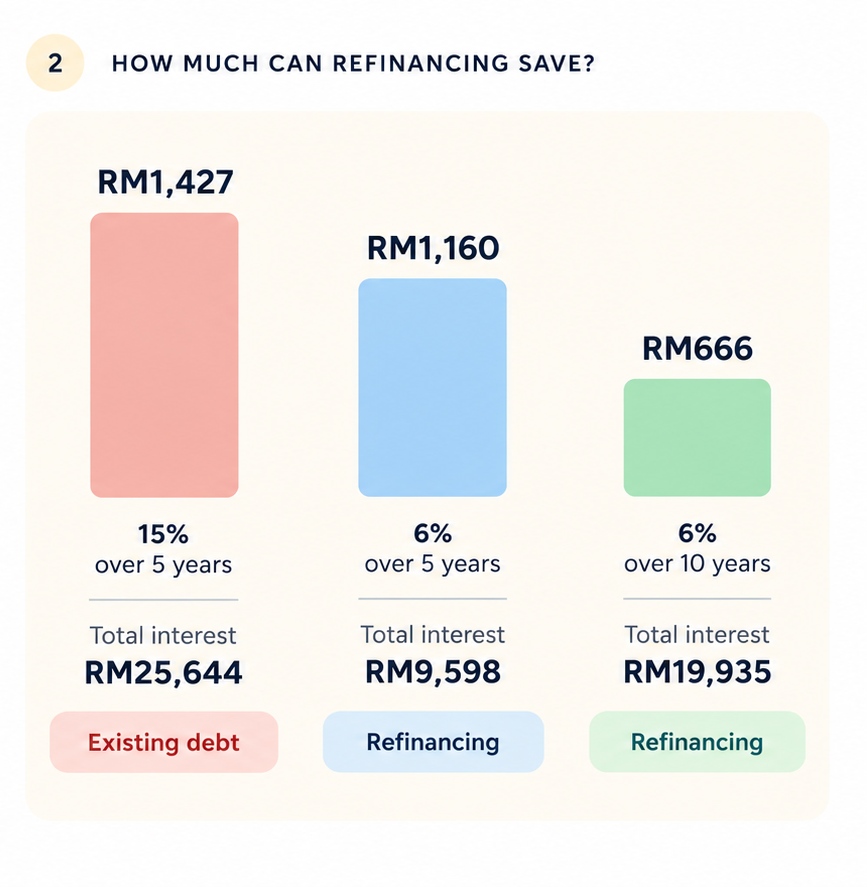
Figures are illustrative and assume fixed nominal annual interest rates calculated on a reducing balance, with equal monthly repayments. They exclude refinancing fees and are not actual financing offers. Actual costs may differ depending on the lender’s rate calculation and financing terms.
The results demonstrate two important points:
- Refinancing at a lower rate over the same five-year period could reduce both monthly repayments and total interest.
- Extending the repayment period to 10 years could reduce monthly instalments further, but would increase total interest compared with the five-year refinancing arrangement.
The lowest monthly repayment is not necessarily the cheapest financing option.
Actual savings depend on your existing debts’ remaining repayment costs, new financing terms and all additional expenses.
What Are the Risks and Benefits of Debt Consolidation Refinancing?
Debt consolidation refinancing offers several potential advantages, but borrowers should understand the risks before proceeding.
| Potential Benefit | Possible Risk |
| Lower monthly repayments | Longer tenure may increase total interest |
| Simpler debt management | New borrowing can recreate debt problems |
| Potentially lower financing rate | Variable rates may increase |
| Access to property equity | Property becomes security for additional debt |
| Improved cash flow | Refinancing fees may reduce savings |
1. Your Property Could Be at Risk
When unsecured debts are consolidated through mortgage refinancing, additional borrowing becomes secured against your property.
If you cannot meet the mortgage repayment obligations, the lender may pursue recovery actions, potentially including foreclosure.
Consider whether the benefits justify placing additional debt against your home.
2. Refinancing May Increase Total Interest
Longer repayment periods can lower monthly instalments while increasing overall financing costs.
Always compare the total remaining cost of your existing debts against the total cost of the proposed refinancing arrangement.
3. Additional Fees May Reduce Savings
Mortgage refinancing may involve:
- Legal fees.
- Property valuation fees.
- Stamp duty.
- Early settlement penalties.
- Insurance or takaful costs, where applicable.
Request an itemised cost breakdown before accepting a financing offer.
4. Debt Consolidation Does Not Prevent Future Borrowing
After settling credit card debts, you may still have access to those credit facilities.
Accumulating new balances could leave you with both a larger mortgage and additional unsecured debt.
Maintaining a realistic budget is essential to making debt consolidation worthwhile.
Is Debt Consolidation Refinancing Right for You?
Debt consolidation refinancing may be worth considering if it improves your repayment affordability or reduces total borrowing costs without introducing unacceptable financial risks.
When Refinancing May Make Sense
- You have multiple high-interest debts.
- The new effective financing rate is more favourable.
- Your monthly repayments are difficult to manage.
- You have sufficient eligible property equity.
- Your income can comfortably support the new repayments.
- The projected savings outweigh refinancing expenses.
When You Should Consider Alternatives
Refinancing may be less suitable if your existing debts are nearly repaid, refinancing costs are substantial or your income is insufficient to support the new arrangement.
Borrowers who are already struggling with repayments should also consider discussing restructuring options with their existing lenders.
Alternatively, Bank Negara Malaysia’s financial capability guidance explains the financial counselling and debt-management assistance available through AKPK.
What Should You Check Before Applying?
Before proceeding with debt consolidation refinancing, prepare the following information:
| What to Prepare | Why It Matters |
| Outstanding loan statements | Confirm remaining debts and settlement amounts |
| Income documents | Assess repayment affordability |
| Existing mortgage details | Check rates, tenure and settlement conditions |
| Property valuation | Estimate potential refinancing eligibility |
| Refinancing quotation | Compare fees and financing costs |
| Monthly household budget | Determine whether repayments remain affordable |
Most importantly, ask the financing provider to explain the total amount payable, including all interest or profit and applicable charges.
This provides a clearer picture of whether refinancing offers genuine financial benefits.
Picking a Suitable Option for Your Needs
Debt consolidation refinancing can help simplify repayments, improve monthly cash flow and potentially reduce financing costs. However, its suitability depends on the new financing terms, associated expenses and your ability to maintain repayments.
For homeowners considering property-backed debt consolidation, WH Asia can help review mortgage refinancing options based on their financial circumstances. Speak with a mortgage consultant and prepare your existing loan statements, income documents and property details to assess whether refinancing may be suitable.
Financial Disclaimer: This article is for general information only and does not constitute personalised financial advice. Financing eligibility, rates, fees and repayment terms depend on individual circumstances and lender requirements. Compare the total costs and risks carefully, and consult a qualified financial professional before making a decision.
Frequently Asked Questions About Debt Consolidation Refinancing in Malaysia
Does Debt Consolidation Refinancing Affect My Credit Score?
Yes, debt consolidation refinancing may affect your credit profile. In Malaysia, new financing applications, outstanding facilities and repayment records may appear in your CCRIS report.
However, CCRIS does not assign credit scores. Consolidation does not automatically improve your creditworthiness, and making repayments on time remains important.
Can I Consolidate Debt Without Owning a Property?
Yes. Debt consolidation in Malaysia may also involve eligible personal financing or credit card balance transfers. Property ownership is only required for financing arrangements secured against property.
Can I Use Mortgage Refinancing to Pay Off Credit Card Debt?
Yes, subject to lender approval and financing conditions. However, converting unsecured credit card debt into property-backed financing introduces additional risks that should be carefully considered.
Can I Apply for Debt Consolidation Refinancing With Bad Credit?
You may enquire about refinancing, but approval depends on the lender’s assessment criteria. A poor repayment history may affect eligibility and the terms offered.
How Long Does Debt Consolidation Refinancing Take in Malaysia?
Processing time depends on the lender, financing arrangement, property valuation and legal documentation. Mortgage refinancing may take longer than a straightforward personal financing application.
Is Debt Consolidation Refinancing Better Than Paying Debts Individually?
Not always. Refinancing may be beneficial when it reduces total financing costs or improves repayment affordability. Paying debts individually may be preferable when their remaining terms are short or refinancing introduces substantial additional expenses.