
Key Takeaways
- OPR changes affect floating-rate loan instalments, with higher rates increasing borrowing costs and lower rates reducing them.
- Bank Negara Malaysia maintained Malaysia’s Overnight Policy Rate (OPR) at 2.75% on 5 November 2026.
- A 0.25 percentage-point rate increase could add approximately RM58 monthly to a RM400,000 mortgage over 30 years.
- Fixed-rate loans are protected from OPR fluctuations during their fixed-rate period.
- Borrowers should assess affordability at higher interest rates before committing to a mortgage.
OPR changes impact your monthly loan instalments by influencing the interest rates charged on floating-rate loans. When Bank Negara Malaysia (BNM) increases the Overnight Policy Rate, affected borrowers pay more interest and may face higher monthly repayments. When the OPR decreases, borrowing costs generally fall.
For Malaysian homeowners and prospective loan applicants, even a small interest rate adjustment can affect monthly cash flow over a mortgage lasting 30 years or longer.
However, your repayment depends on more than the OPR. Your outstanding loan balance, remaining repayment period and financing structure also influence the outcome.
Understanding these factors helps you estimate repayment changes and make informed borrowing decisions.
OPR Changes at a Glance
| OPR Movement | Floating-Rate Loans | Fixed-Rate Loans |
| OPR increases | Instalments may increase | Existing fixed rate remains unchanged |
| OPR decreases | Instalments may decrease | Existing fixed rate remains unchanged |
| OPR stays unchanged | No OPR-driven adjustment | No direct impact |
| Multiple OPR increases | Repayment pressure may accumulate | Protected during fixed-rate period |
Actual repayment adjustments depend on your loan agreement, outstanding balance and the bank’s recalculation process.
Read More: Home Loan Approval Process in Malaysia: Step-by-Step
What Is the OPR?
The Overnight Policy Rate (OPR) is Malaysia’s benchmark monetary policy interest rate, determined by Bank Negara Malaysia.
It guides short-term interest rates in the banking system and influences borrowing costs, deposit rates, consumer spending and broader economic activity.
BNM’s Monetary Policy Committee (MPC) reviews the OPR based on economic conditions, including inflation, domestic demand and financial stability.
What Is the Current OPR in Malaysia?
As of 17 November 2026, Malaysia’s OPR stands at 2.75%, following BNM’s decision to maintain the rate on 5 November 2026.
In July 2025, BNM reduced the OPR from 3.00% to 2.75%. The rate subsequently remained unchanged through the November 2026 monetary policy decision.
You can verify the latest rate through Bank Negara Malaysia’s official OPR decisions.
However, the OPR is not necessarily the interest rate charged on your mortgage. Your actual financing rate depends on your loan’s reference rate and the additional spread applied by your bank.
Why Does Bank Negara Malaysia Change the OPR?
BNM adjusts monetary policy to maintain price stability while supporting sustainable economic growth.
An OPR increase makes borrowing more expensive, which can moderate spending and help manage inflationary pressure.
An OPR reduction lowers financing costs and can encourage consumption, investment and borrowing when economic conditions warrant support.
However, borrowers should not assume that future OPR reductions are guaranteed.
Mortgage affordability should account for potential interest rate increases rather than depend on predictions about future OPR decisions.
How OPR Affects Floating Loans
Floating-rate loans have interest rates that adjust according to a specified benchmark. In Malaysia, OPR movements influence the reference rates used for these financing products.
This is particularly relevant for housing loans, which often involve large balances and lengthy repayment periods.
Understanding SBR, BR and BLR
Malaysian borrowers may encounter several reference rates in their financing agreements.
| Reference Rate | Meaning | Application |
| SBR | Standardised Base Rate | New retail floating-rate loans from August 2022 |
| BR | Base Rate | Certain existing floating-rate loans |
| BLR | Base Lending Rate | Older floating-rate financing agreements |
| OPR | Overnight Policy Rate | Benchmark guiding reference-rate movements |
Since 1 August 2022, the Standardised Base Rate has been used for new retail floating-rate loans.
The SBR is directly linked to BNM’s OPR. When the OPR changes by 0.25 percentage points, the SBR changes by the same amount.
Existing floating-rate loans linked to BR or BLR also reflect OPR movements under BNM’s reference rate framework.
For an SBR-linked mortgage:
Effective Lending Rate = SBR + Bank’s Spread
For example:
- SBR: 2.75%
- Bank’s spread: 1.25 percentage points
- Effective lending rate: 4.00% annually
If the OPR increases to 3.00%, the SBR also rises to 3.00%.
Assuming the contractual spread remains unchanged, the effective lending rate becomes 4.25%.
How Much Will Your Monthly Instalment Increase?
Consider a Malaysian homeowner with the following mortgage:
- Outstanding loan balance: RM400,000
- Remaining tenure: 30 years
- Current effective interest rate: 4.00% annually
- Repayment structure: Monthly principal-and-interest instalments
Using a standard mortgage repayment calculation:
At 4.00% interest:
- Monthly instalment: RM1,909.66
After a 0.25 percentage-point increase to 4.25%:
- Monthly instalment: RM1,967.76
Additional monthly payment: RM58.10
That means paying approximately RM697 more over 12 months, assuming both repayment schedules are recalculated over the same remaining tenure. This represents additional repayments, not necessarily the same amount of additional interest.
Although RM58 might appear manageable, a larger loan balance or further rate increases could place greater pressure on household finances.
Comparing Different OPR Increase Scenarios
The following graphic illustrates how different interest rates affect the same RM400,000 mortgage over 30 years.
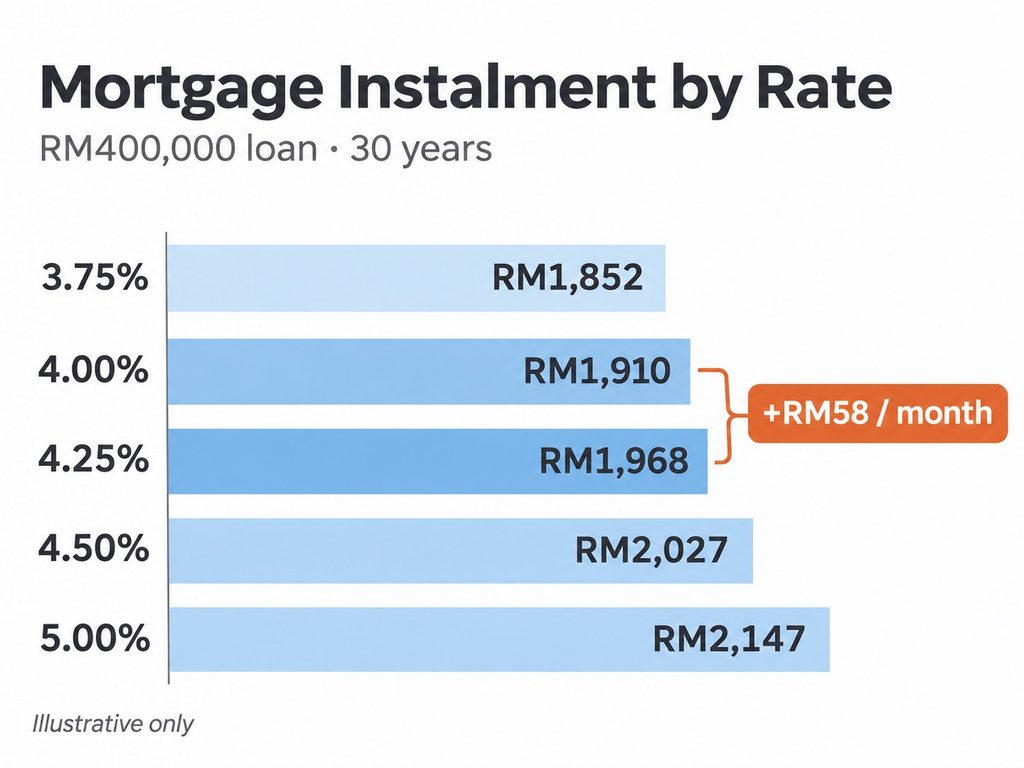
Note: These are hypothetical calculations, not predictions of future Malaysian interest rates. They assume monthly compounding, a fully amortising loan, the same outstanding balance and remaining tenure, with no additional fees. Actual bank calculations may differ.
Will Your Loan Tenure Change Instead?
Not every OPR adjustment results in an immediately noticeable change to your monthly repayment.
Depending on your financing arrangement and the bank’s procedures, an adjustment may affect:
- Your monthly instalment amount.
- Your remaining financing tenure.
- The proportion of each payment allocated towards interest and principal.
If interest rates increase while monthly payments remain unchanged, less of each payment may reduce the outstanding principal. This could extend the repayment period or require subsequent adjustments.
BNM’s revised Reference Rate Framework, issued on 27 March 2026, strengthens requirements for timely repayment adjustments and clearer borrower notifications. The first implementation phase began on 1 July 2026, with the second scheduled for 2 January 2028.
Borrowers should check their latest repayment schedules rather than assume an unchanged monthly deduction means an unchanged borrowing cost.
Do OPR Changes Affect All Types of Loans?
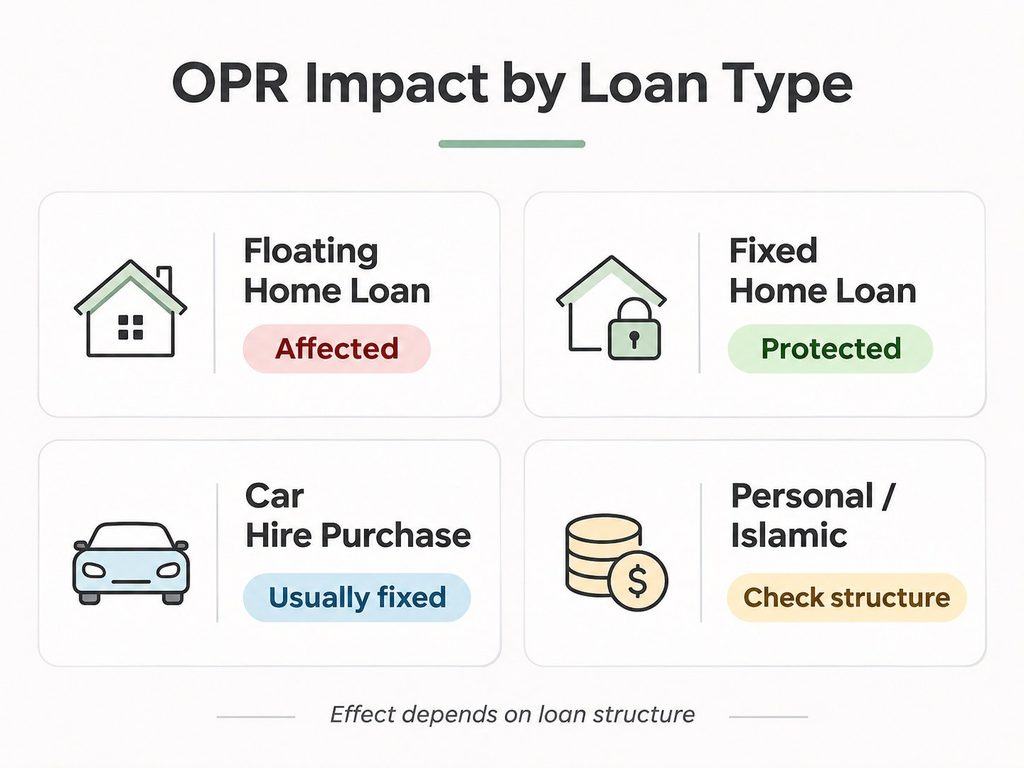
No. The impact depends primarily on whether the financing arrangement uses a fixed or floating interest rate.
Floating-Rate Housing Loans
These are exposed to changes in their reference rates. When the applicable benchmark increases, interest costs rise.
Fixed-Rate Housing Loans
A fixed-rate mortgage maintains its contracted interest rate during the specified fixed-rate period. However, some packages offer fixed rates initially before switching to floating rates.
Car Loans
Many existing Malaysian hire-purchase agreements use fixed rates, meaning their scheduled repayments are not directly affected by OPR changes.
However, the Hire-Purchase (Amendment) Act 2026 introduced changes to how financing costs are calculated and disclosed, with a transition period extending to 31 March 2027.
Other vehicle financing products may have variable-rate features, so borrowers should review their agreements.
Personal Loans
Fixed-rate personal loans are insulated from subsequent OPR changes during their fixed-rate period. Floating-rate personal financing products can be affected.
Islamic Home Financing
Islamic home financing may use fixed or floating profit-rate structures.
For floating-rate facilities, OPR movements can influence the applicable profit rate and repayment amount, subject to the financing agreement.
The important distinction is the financing structure, rather than whether the product is conventional or Islamic.
What to Do When OPR Rises
When the OPR rises, borrowers should review their repayment obligations, assess affordability and consider appropriate adjustments before instalments become difficult to manage.
1. Check Your Current Loan Rate and Repayment Schedule
Start by reviewing your latest mortgage statement and financing agreement.
Identify:
- Outstanding principal balance.
- Current effective interest or profit rate.
- Applicable reference rate.
- Remaining financing tenure.
- Revised monthly repayment amount.
BNM requires banks to inform affected borrowers of repayment changes, with notice provided at least seven calendar days before the revised instalment becomes due.
If the revised figure seems inconsistent with your expectations, request a repayment breakdown from your bank.
2. Test Your Budget Against Higher Interest Rates
Before accepting a new mortgage, calculate whether you can afford it if borrowing rates increase.
For example, a household currently paying RM1,910 monthly could test its budget against repayments of approximately RM2,027 and RM2,147.
These represent the illustrative 4.50% and 5.00% scenarios discussed earlier.
Compare the higher repayments against your disposable income after accounting for:
- Existing loan commitments.
- Household expenses.
- Insurance and maintenance costs.
- Savings contributions.
- Emergency expenses.
A mortgage that is affordable at today’s rate may become restrictive when financing costs and living expenses increase together.
3. Maintain an Emergency Fund
An emergency fund helps absorb unexpected costs, including temporary repayment increases.
A useful goal is to build an emergency fund covering around six months of essential expenses, in line with guidance from PIDM.
The appropriate amount depends on your income stability, household commitments and financial circumstances.
For borrowers with limited savings, building a reasonable cash reserve may be more important than making aggressive mortgage prepayments.
4. Consider Extra Principal Repayments
Making additional principal repayments can reduce the outstanding balance used to calculate future interest.
For example, a borrower with available surplus cash might consider paying an additional RM200 monthly towards the mortgage.
However, actual savings depend on whether the bank treats these payments as principal reductions, advance instalments or funds within a flexi facility.
Before making additional payments, confirm:
- Whether advance payments reduce the interest-bearing balance.
- Whether prepayment penalties apply.
- Whether excess funds can be withdrawn.
- How payments affect future instalments and tenure.
Borrowers should also retain sufficient emergency savings.
5. Review Refinancing Options
Refinancing involves replacing an existing mortgage with a new financing arrangement.
It may be worth considering if another bank offers a meaningfully lower effective interest rate or more suitable repayment terms.
However, refinancing is not automatically beneficial when the OPR increases. Both existing and newly offered floating-rate mortgages may respond to the same benchmark changes.
Potential costs include legal fees, valuation expenses and applicable early settlement charges.
Compare the overall financing cost and remaining repayment period, not just the advertised monthly instalment.
6. Speak to Your Bank Before Missing Payments
If higher repayments become difficult to manage, contact your bank early.
Depending on your circumstances, the bank may discuss repayment assistance, restructuring or other available arrangements.
These options can provide short-term relief, but extending the repayment period may increase overall financing costs.
Borrowers who need independent financial guidance can also approach Malaysia’s Credit Counselling and Debt Management Agency (AKPK).
BNM provides further information about repayment changes and available assistance in its Monetary Stability guidance.
Should You Apply for a Home Loan When the OPR Is High?
A higher OPR does not automatically mean you should delay buying a property.
The more useful question is whether the mortgage remains affordable under realistic repayment scenarios.
A home loan and purchase may still be financially manageable when:
- Your employment and income are reasonably stable.
- You have sufficient savings for the deposit and associated costs.
- Monthly repayments leave room for essential expenses.
- You can absorb potential interest rate increases.
- The property suits your long-term housing needs.
However, postponing or reducing your intended loan amount may be sensible if the proposed repayment already consumes most of your available monthly income.
What Should You Compare Before Choosing a Mortgage?
When reviewing financing offers, consider the following:
| Factor | What to Check |
| Effective lending rate | Actual rate charged, including the spread |
| Rate structure | Fixed, floating or introductory fixed period |
| Repayment flexibility | Extra payments, redraw and flexi features |
| Lock-in conditions | Early settlement restrictions and charges |
| Total financing cost | Interest, fees and repayment period |
A slightly lower advertised rate is not necessarily the better option if the package carries restrictive conditions or unsuitable repayment features.
For loan applicants, it is also worth reviewing the debt service ratio (DSR), which measures monthly debt repayments against income.
BNM commonly describes DSR using net monthly income after statutory deductions, although individual lenders may apply different assessment methods.
There is no single DSR threshold that guarantees mortgage approval across all Malaysian banks.
Lenders also consider income stability, existing commitments and credit history.
The safest approach is to calculate what you can comfortably repay before considering the maximum amount a lender might approve.
OPR Changes and Your Loan
OPR changes impact borrowing costs, but the actual effect on your instalments depends on your loan balance, remaining tenure and financing structure.
For Malaysian borrowers, understanding how floating-rate mortgages respond to interest rate movements is essential to maintaining financial flexibility.
Before committing to a mortgage, assess different repayment scenarios and choose financing terms that remain manageable even when borrowing costs increase.
If you are comparing housing loan options, WH Asia can help you evaluate financing arrangements based on your budget and property plans. Speak with a mortgage consultant to review your expected instalments, loan eligibility and available mortgage options before making a commitment.
Disclaimer: This article is for general information only and does not constitute personalised financial advice. Actual financing costs, repayments and loan eligibility depend on your bank’s terms and your financial circumstances. Consult a qualified professional before making major financial decisions.
Sources
- Bank Negara Malaysia. Monetary Policy Statement, 5 November 2026.
- Bank Negara Malaysia. Monetary Policy Statement, 9 July 2025.
- Bank Negara Malaysia. Monetary Stability.
- Bank Negara Malaysia. Revised Reference Rate Framework, 11 August 2021.
- Bank Negara Malaysia. Reference Rate Framework Policy Document, 27 March 2026.
- Bank Negara Malaysia. Consumer Guide: Hire-Purchase (Amendment) Act 2026, 17 March 2026.
- Bank Negara Malaysia. Financial Stability Review, First Half 2024.
- Perbadanan Insurans Deposit Malaysia. Emergency Savings Calculator.
Frequently Asked Questions About OPR Changes Impact
How Often Does the OPR Change in Malaysia?
Bank Negara Malaysia reviews monetary policy at scheduled MPC meetings. However, the OPR does not necessarily change at every meeting. Decisions depend on economic conditions, inflation and financial stability considerations.
Will My Instalment Increase Immediately After an OPR Hike?
Not necessarily. Your bank must implement applicable rate and repayment adjustments according to the relevant framework and notify you of the revised amount and effective date.
Can My Housing Loan Instalment Increase Even When the OPR Falls?
Yes. A repayment recalculation may reflect earlier rate changes, outstanding balances, previous repayment arrangements or other account-specific factors. Ask your bank for a breakdown if your instalment rises unexpectedly.
Does a 0.25% OPR Increase Mean My Instalment Increases by 0.25%?
No. A 0.25 percentage-point OPR increase affects the applicable loan interest rate, not the monthly instalment by the same percentage. The repayment change depends on your outstanding principal, interest rate and remaining tenure.
Can I Switch From a Floating-Rate to a Fixed-Rate Mortgage?
Potentially, depending on available financing products and lender approval. Switching may involve refinancing costs, new eligibility assessments and different loan conditions. Compare total borrowing costs before proceeding.
Is It Better to Take a Shorter Mortgage Tenure When the OPR Is High?
A shorter tenure reduces the time over which interest accumulates but requires higher monthly repayments. It may suit borrowers with sufficient disposable income, while a longer tenure offers more monthly flexibility at potentially greater total interest cost.