
Key Takeaways
- A lock-in period is a contractual timeframe during which settling a loan early may result in additional charges.
- Some Malaysian home loan packages have lock-in periods of two to five years, while others have no lock-in period.
- Early settlement charges may be calculated using the original loan amount, outstanding balance or another method specified in the financing agreement.
- Selling your property, refinancing or fully repaying your loan during the lock-in period may trigger additional charges.
- Loans without lock-in periods offer greater repayment flexibility but may still involve other settlement costs.
When borrowing money in Malaysia, a lock-in period refers to a specified timeframe during which borrowers may incur charges for settling their loans ahead of schedule. While not every Malaysian loan comes with this condition, it is often associated with property financing.
When comparing loans, borrowers often consider interest rates, monthly instalments and loan approval requirements. However, overlooking the lock-in clause could cost you thousands of ringgit if your financial circumstances change.
Understanding how lock-in periods work can help you avoid unnecessary charges and make better borrowing decisions.
Read More: How OPR Changes Impact Your Loan Instalments in Malaysia
What is a Lock-In Period?
A lock-in period is a predetermined duration within a loan agreement during which borrowers may be charged a fee for fully repaying or terminating their financing facility.
In Malaysia, some home loan packages have lock-in periods of two to five years, while others have no lock-in period. The duration and applicable charges vary depending on the lender and financing agreement.
Lock-in periods may help lenders recover certain financing-related costs when borrowers settle their loans early, subject to applicable regulatory requirements.
A lock-in period does not necessarily prevent you from settling your loan early. Instead, it may make doing so more expensive.
How Does a Lock-In Period Work?
Consider a borrower who takes out a RM500,000 home loan with the following hypothetical conditions:
| Loan Details | Example |
| Original loan amount | RM500,000 |
| Loan tenure | 30 years |
| Lock-in period | 3 years |
| Lock-in commencement date | 1 June 2026 |
| Lock-in expiry date | 1 June 2029 |
| Early settlement penalty | 3% of outstanding principal |
If the borrower fully settles the loan before the lock-in period expires, an early settlement charge may apply.
Once the lock-in period ends, the borrower can settle the loan without the specific lock-in penalty, although other contractual charges may remain applicable.
The 3% penalty rate used in this example is illustrative and does not represent a standard market rate.
When Does a Lock-In Period Start?
Depending on your financing agreement, the lock-in period may commence from:
- The first loan disbursement date.
- The full loan disbursement date.
- Another commencement date specified in the agreement.
This distinction is particularly important when purchasing properties under construction, where financing may be released progressively to the developer.
Always request written confirmation of your exact lock-in expiry date before arranging a property sale or refinancing.
Which Types of Loans Have Lock-In Periods in Malaysia?
Although lock-in periods are often associated with mortgages, other borrowing arrangements may also include early settlement conditions.
| Type of Loan | Lock-In Period or Early Settlement Conditions |
| Residential home loans | May apply, depending on the financing package |
| Commercial property loans | Depends on the financing agreement |
| Mortgage refinancing | May introduce a new lock-in period |
| Personal loans | Product-specific settlement conditions may apply |
| Islamic home financing | Subject to financing terms and applicable Shariah requirements |
| Non-bank property financing | Depends on the provider, financing agreement and applicable regulatory requirements |
Borrowers should not assume that all loans within the same category have identical conditions. Lenders may revise their early settlement charges or introduce different conditions for new financing packages, subject to applicable contractual and regulatory requirements.
What Can Trigger an Early Settlement Penalty?
An early settlement penalty may apply when an action results in the full repayment or termination of your financing facility during its lock-in period.
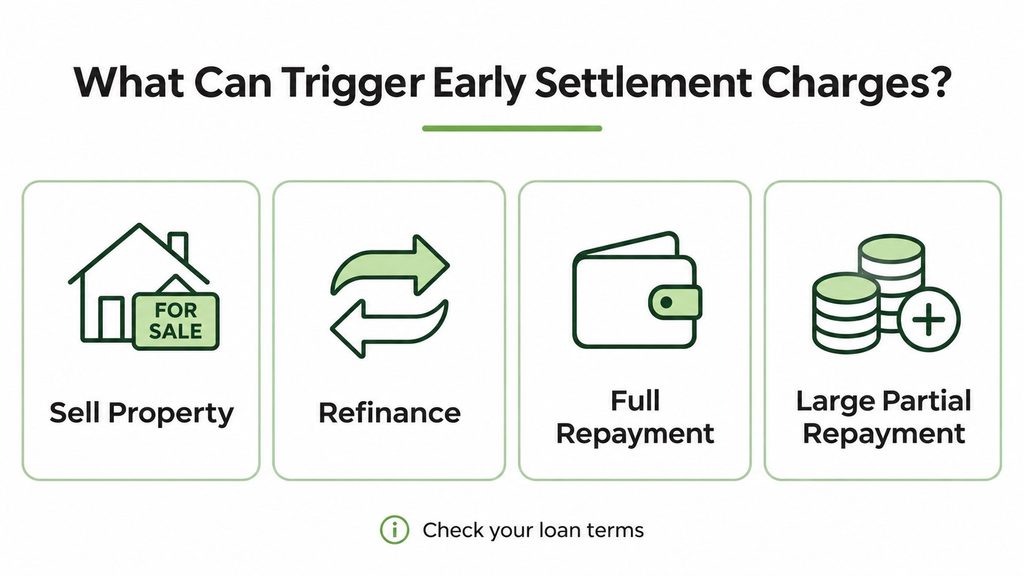
Making additional monthly repayments does not automatically trigger a lock-in penalty. Check whether your lender treats partial repayment differently from full settlement and whether additional payments directly reduce your outstanding principal.
Penalty Fees: How Much Could Breaking a Lock-In Period Cost?
Early settlement charges for Malaysian home loans vary depending on the lender and financing package. Some lenders impose percentage-based charges, while others offer financing without lock-in penalties.
Depending on your financing agreement, the charge may be calculated using the original loan amount, outstanding principal or another specified method.
For example, AmBank announced that its previous 2% early settlement charge for applicable housing and property financing would not be imposed from 3 January 2025 until further notice.
As lenders may revise their charges over time, always check your latest financing terms and request an official settlement quotation before making a decision.
How to Calculate an Early Settlement Penalty
For loans with a straightforward percentage-based penalty, the calculation is:
Early settlement penalty = Applicable loan amount × Penalty rate
Using an illustrative penalty rate of 3%, the following table shows how much early settlement could cost. This percentage is used for demonstration purposes and does not represent a standard market rate.
| Applicable Loan Amount | Penalty Rate | Early Settlement Fee |
| RM200,000 | 3% | RM6,000 |
| RM300,000 | 3% | RM9,000 |
| RM400,000 | 3% | RM12,000 |
| RM500,000 | 3% | RM15,000 |
| RM750,000 | 3% | RM22,500 |
| RM1,000,000 | 3% | RM30,000 |
These figures are illustrative. Actual charges depend on the terms of your financing agreement and applicable regulatory requirements.
Original Loan Amount vs Outstanding Loan Balance
Two borrowers with identical loan amounts and penalty rates could pay different early settlement fees depending on how their agreements are structured.
Consider a RM500,000 home loan with an outstanding balance of RM450,000 and an illustrative 3% early settlement penalty.
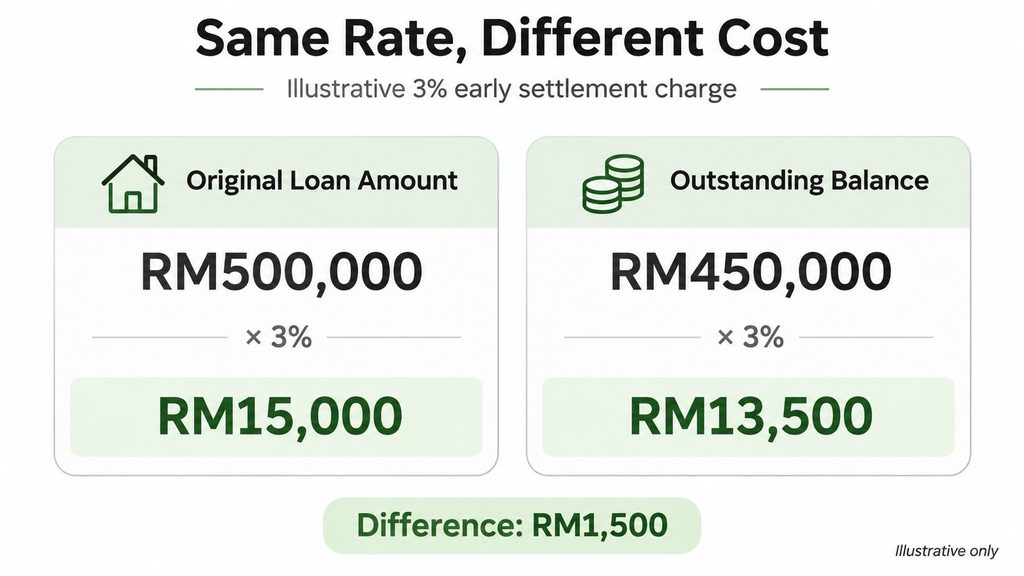
Although both calculations use the same penalty rate, the borrower could pay RM1,500 more under the original loan amount method.
Some lenders may also use alternative formulas or recover eligible financing costs previously absorbed by them. Therefore, borrowers should review the calculation method rather than simply comparing penalty percentages.
Is It Worth Breaking a Lock-In Period?
Breaking a lock-in period may be worthwhile if the financial benefits of terminating your existing loan exceed the associated costs.
This is particularly relevant when refinancing offers substantial potential interest savings.
Worked Example: Refinancing During a Lock-In Period
Suppose you are considering refinancing your home loan to obtain more favourable repayment terms.
| Refinancing Details | Estimated Amount |
| Outstanding home loan | RM450,000 |
| Early settlement penalty (3%) | RM13,500 |
| Estimated refinancing expenses | RM5,000 |
| Total switching costs | RM18,500 |
| Expected monthly repayment reduction | RM400 |
To estimate how long it takes for the reduction in your monthly instalments to offset your switching costs:
Cash-flow break-even period = Total switching costs ÷ Monthly repayment reduction
RM18,500 ÷ RM400 = 46.25 months.
Under these assumptions, it would take approximately 47 monthly payments for the reduction in monthly instalments to offset your switching costs.
However, this simplified calculation measures cash-flow savings rather than total interest savings. It does not account for interest rate changes, differences in loan tenure or principal reduction.
A lower monthly instalment does not necessarily mean lower total borrowing costs, particularly if refinancing extends your repayment period.
Always compare the remaining cost of your existing loan against the total cost of the proposed refinancing package, including applicable legal fees, valuation fees, stamp duty and other switching expenses.
When Should You Consider Waiting?
Waiting until your lock-in period expires may be more financially sensible if:
- Your lock-in period ends within the next few months.
- Refinancing offers only marginal interest savings.
- You expect to sell the property before recovering your refinancing costs.
- Breaking the lock-in would significantly reduce your emergency savings.
- Your existing lender is willing to offer more favourable repayment terms.
Before switching lenders, consider requesting a rate review from your existing financial institution.
Finding Loans Without Lock-Ins
Loans without lock-in periods allow borrowers to settle their financing earlier without incurring a specific lock-in penalty.
However, having no lock-in period does not necessarily mean there are no early settlement costs. Some lenders may still recover actual expenses associated with early settlement, where permitted.
For example, BSN’s MyHome Product Disclosure Sheet provides for no lock-in period, but the bank may recover actual costs incurred as a result of early settlement.
Always check for additional charges and notice requirements before choosing a financing package.
Loans With vs Without Lock-In Periods
| Comparison | With Lock-In Period | Without Lock-In Period |
| Early settlement | May incur additional charges | No specific lock-in penalty |
| Interest rates | Varies by financing package | Varies by financing package |
| Refinancing flexibility | May involve additional settlement costs | Greater flexibility |
| Property sale | May increase settlement costs | Fewer lock-in-related concerns |
| Additional settlement fees | May apply | May still apply |
| May be suitable for | Borrowers planning to retain their loan long-term | Borrowers requiring greater repayment flexibility |
Who Should Consider a Loan Without a Lock-In Period?
A financing package without a lock-in period may be suitable for:
- Property investors planning to sell within a few years.
- Business owners with fluctuating income who value repayment flexibility.
- Borrowers expecting a substantial financial windfall.
- Homeowners anticipating relocation.
- Individuals planning to refinance when better opportunities become available.
Nevertheless, a loan without a lock-in period is not automatically the cheapest option. Compare interest rates, upfront expenses, repayment terms and total borrowing costs before committing.
How Do Lock-In Periods Work for Islamic Financing in Malaysia?
Islamic financing facilities may also include early settlement conditions, although their financing structures differ from conventional interest-based loans.
One important concept is ibra’, which refers to a rebate that reduces the amount payable upon early settlement of applicable financing facilities.
Under Bank Negara Malaysia’s Shariah requirements, Islamic financial institutions must provide ibra’ for early settlement of applicable sale-based financing.
For financing covered by these requirements, lenders cannot impose punitive early settlement charges. However, they may recover eligible costs incurred as a result of early settlement, subject to applicable regulatory requirements.
Borrowers should clarify how their rebate is calculated and whether any permissible settlement charges apply.
Request an official settlement quotation rather than estimating the amount based solely on your remaining monthly instalments.
What Should You Check Before Signing a Loan Agreement?
Bank Negara Malaysia’s Policy Document on Product Transparency and Disclosure, issued in December 2024, sets disclosure requirements intended to help financial consumers make informed decisions.
When comparing Malaysian loan packages, review the Product Disclosure Sheet (PDS), Letter of Offer and financing agreement.
Pay particular attention to the following conditions:
| Loan Agreement Condition | What You Should Ask |
| Lock-in duration | How long does the lock-in period last? |
| Commencement date | When does the lock-in period begin? |
| Penalty percentage | How much will I be charged for early settlement? |
| Calculation method | Is the charge based on the original amount, outstanding balance or another method? |
| Partial repayment | Can I make additional repayments without charges? |
| Refinancing conditions | Can I switch financing packages without penalties? |
| Notice requirements | Must I notify the lender before settling? |
| Additional expenses | Are there other settlement charges? |
| Penalty exemptions | Can the penalty be waived under certain circumstances? |
Avoid relying exclusively on verbal assurances. Request written confirmation of any repayment flexibility, fee waivers or special conditions before accepting a financing offer.
How Can You Avoid Unnecessary Lock-In Penalties?
While unexpected financial circumstances cannot always be avoided, careful planning can reduce your exposure to early settlement charges.
- Match your loan to your financial plans. Avoid lengthy lock-in periods if you anticipate selling your property or refinancing within a few years.
- Negotiate before accepting a loan. Ask whether shorter lock-in periods or more flexible repayment conditions are available.
- Keep track of your expiry date. Coordinate property sales and refinancing arrangements to avoid settling your loan prematurely.
- Request a redemption statement. Obtain an official breakdown of your outstanding balance, settlement penalties and other applicable charges.
- Ask about penalty waivers. Some lenders may consider reducing or waiving charges depending on their policies and your circumstances.
- Compare total borrowing costs. Look beyond advertised interest rates and consider legal fees, settlement charges and other financing expenses.
Choosing a loan that accommodates your future financial plans can be more valuable than securing the lowest advertised interest rate.
Getting Lock-In Periods Right
Understanding lock-in periods in Malaysia is an important part of responsible borrowing. By reviewing penalty calculations, settlement conditions and repayment flexibility, you can reduce unnecessary expenses and choose financing that aligns with your long-term goals.
If you are considering property financing or reviewing your existing borrowing arrangements, WH Asia can help you better understand your available mortgage options.
Speak with a WH Asia mortgage consultant to discuss your financial requirements, repayment flexibility and potential borrowing costs before making a commitment.
Disclaimer: This article is for general informational purposes only and does not constitute personalised financial advice. Loan terms, interest rates and settlement charges may vary between lenders and financing packages. Always review your financing agreement and seek professional guidance before making financial decisions.
Frequently Asked Questions About Lock-In Periods for Malaysian Borrowers
Is a Lock-In Period Mandatory for All Loans in Malaysia?
No. Lock-in periods depend on the lender, financing product and contractual terms. Some loans offer early settlement without lock-in penalties, although other charges may apply.
Can I Negotiate My Lock-In Period After Signing a Loan Agreement?
You can request revised terms from your lender. However, approval depends on its policies and willingness to amend your existing financing agreement. Any agreed changes should be confirmed in writing.
Can a Bank Extend My Lock-In Period?
Restructuring, refinancing or accepting a revised financing package may introduce a new or extended lock-in period under the agreed terms. Review any amended agreement before accepting it, particularly the new commencement and expiry dates.
Does Breaking a Lock-In Period Affect My Credit Score?
Settling a loan during its lock-in period does not itself constitute a default, provided you pay all outstanding contractual amounts. However, missed repayments or unpaid settlement charges may negatively affect your credit standing. The impact on your credit score depends on your overall credit profile and the assessment criteria used by credit reporting agencies.
Can a Lock-In Period Be Waived?
Some lenders may agree to waive early settlement penalties depending on their policies and the borrower’s circumstances. Waivers are not guaranteed and should be confirmed in writing before proceeding with early settlement.
Is a Shorter Lock-In Period Always Better?
Not necessarily. While a shorter lock-in period offers greater repayment flexibility, it does not automatically make a loan more affordable. Compare interest rates, fees, total borrowing costs and your future financial plans before choosing a financing package.