

Key Takeaways
- A personal loan blacklist is not an official BNM blacklist. Banks assess repayment records, outstanding debts and lending risks.
- Check your CCRIS and CTOS reports to identify overdue payments, inaccurate information and unresolved financial obligations.
- Settle overdue payments or negotiate repayment assistance before applying for another personal loan.
- CCRIS displays 12 months of repayment history, so previous late payments remain visible until they leave the reporting window.
- Rebuilding credit requires consistent repayments, manageable debt and patience. A clean report does not guarantee loan approval.
To rebuild credit after a personal loan blacklist in Malaysia, check your CCRIS and CTOS reports, resolve overdue payments and maintain a consistent repayment record. Your credit profile can improve over time, but settling outstanding debts does not automatically erase missed payments or guarantee another loan.
Understanding why lenders rejected your application is the first step towards recovery.
This guide explains what a loan blacklist means, five practical steps to rebuild credit and how long recovery takes.
Personal Loan Blacklist Recovery at a Glance
| Your Situation | Recommended Action | What to Expect |
| Missed loan repayments | Settle arrears or negotiate repayment assistance | Updated repayment status in the next reporting cycle |
| Poor CCRIS repayment history | Maintain consistent on-time payments | Previous arrears remain visible within the 12-month history |
| Inaccurate CTOS information | Submit a correction request with evidence | Correction of verified errors |
| Multiple outstanding debts | Reduce commitments and prioritise overdue accounts | Lower monthly repayment burden |
| Loan rejected despite improved records | Review affordability and lender requirements | Eligibility depends on your financial profile |
The most effective way to rebuild credit is to resolve repayment problems first, then demonstrate that you can manage your financial commitments consistently.
What Does a Personal Loan Blacklist Mean in Malaysia?
A personal loan blacklist is an informal term describing difficulty obtaining financing because of poor repayment history, outstanding debts or other credit-related concerns.
Bank Negara Malaysia (BNM) does not maintain a blacklist of borrowers.
Its Central Credit Reference Information System (CCRIS) provides factual credit information reported by participating financial institutions. Banks use this information alongside their internal lending criteria.
Understanding CCRIS and CTOS
CCRIS and CTOS serve different purposes.
| Feature | CCRIS | CTOS |
| Managed by | Bank Negara Malaysia | Private credit reporting agency |
| Main purpose | Reports financing and repayment information | Provides broader credit information |
| Credit score | No | Yes, through certain reports |
| Repayment history | Latest 12 months | May incorporate CCRIS information |
| Official blacklist | No | No |
Neither organisation decides whether a bank should approve your personal loan. That decision belongs to the lender.
Why Do Banks Reject Personal Loan Applications?
Common reasons include:
- Missed repayments: Previous arrears indicate difficulty meeting financial commitments.
- High monthly commitments: Existing instalments may leave insufficient disposable income.
- Unstable income: Irregular earnings can complicate affordability assessments.
- Multiple recent applications: Frequent applications may raise concerns about borrowing needs.
- Existing financial issues: Unresolved debt-related proceedings can affect lending decisions.
Someone earning RM4,000 monthly with RM2,500 in existing debt repayments may face affordability concerns even with a clean repayment record.
Improving your credit score alone is not always enough to qualify for another loan.
5 Steps to Clear Your Name From a Personal Loan Blacklist
Recovering from a personal loan blacklist requires addressing existing credit problems before rebuilding your borrowing profile.
Step 1: Check Your CCRIS and CTOS Credit Reports
Review your credit records to identify what may be affecting your loan eligibility.
You can obtain your CCRIS report for free through BNM’s eCCRIS platform. For a broader assessment, consider checking your CTOS report. Reports containing a CTOS Score and CCRIS information may require payment.
Pay attention to:
- Outstanding personal loan balances
- Missed or overdue instalments
- Accounts under special attention
- Recently submitted credit applications
- Incorrect outstanding balances
In CCRIS, repayment conduct is displayed using numerical indicators.
- 0: No instalments in arrears
- 1: One instalment in arrears
- 2: Two instalments in arrears
- 3: Three instalments in arrears
Several missed instalments indicate repayment problems requiring attention.
Practical tip: List every account with outstanding arrears and prioritise resolving these accounts before seeking new financing.
Step 2: Settle Outstanding Debts or Negotiate Repayment Assistance
Addressing overdue repayments is an important step towards improving your credit standing.
Contact your lender to confirm the outstanding amount, including applicable charges. Request written confirmation after completing payment.
If full repayment is unaffordable, discuss alternative arrangements:
- Revised monthly instalments
- Extended repayment periods
- Rescheduled payment arrangements
- Other repayment assistance
BNM’s repayment assistance guidance explains how borrowers experiencing financial difficulties can approach participating banks for support.
What If You Cannot Afford Your Personal Loan Repayments?
Consider contacting Agensi Kaunseling dan Pengurusan Kredit (AKPK).
AKPK provides free financial counselling and debt-management assistance to eligible Malaysian borrowers.
Through its Debt Management Programme, eligible individuals may receive assistance in restructuring financial obligations.
However, entering a debt-management arrangement does not automatically restore borrowing eligibility.
Important: Avoid taking another high-interest loan to repay existing debts. Replacing one unaffordable loan with another can worsen your financial position.
Step 3: Correct Inaccurate Information in Your Credit Reports
Sometimes, loan applications are affected by incorrect or outdated information.
For example, you may have settled a personal loan, but your report still shows an incorrect outstanding balance after the relevant reporting cycle.
Gather supporting documents such as:
- Loan settlement letters
- Payment receipts
- Bank statements
- Written confirmation from your lender
For CCRIS inaccuracies, contact the financial institution responsible for reporting the account.
BNM states that participating institutions are responsible for correcting inaccurate information. Under normal circumstances, they may take up to 14 working days to provide feedback on disputes. Completing a correction may take additional time.
For incorrect CTOS information, submit a correction request directly to the agency.
Settling a debt does not immediately remove genuine missed payments from CCRIS. Previous arrears remain visible within its rolling 12-month history. Different reporting and retention rules may apply to private credit reporting agencies.
Be cautious of companies promising immediate credit record removal for a fee.
Step 4: Rebuild Your Credit Through Consistent Repayments
Once overdue accounts have been addressed, focus on establishing a stronger repayment record.
Pay Every Instalment on Time
Set up automatic payments or reminders for personal loans, car financing and other commitments.
Consistent repayment matters because CCRIS displays the most recent 12 months of repayment conduct.
Reduce Outstanding Credit Card Balances
Avoid carrying unnecessarily high credit card balances.
For example:
- Credit limit: RM10,000
- Outstanding balance: RM8,000
- Credit utilisation: 80%
Reducing the outstanding balance to RM3,000 lowers utilisation to 30%.
Credit Utilisation = (Outstanding Balance ÷ Credit Limit) × 100
Lower utilisation reduces your outstanding revolving credit exposure. However, 30% is not a guaranteed threshold for improving your credit score.
Avoid Unnecessary Loan Applications
Submitting several applications within a short period may raise concerns during a lender’s assessment.
Review your eligibility before applying.
Maintain a Realistic Monthly Budget
Prioritise essential expenses, existing repayments and emergency savings. Avoid borrowing solely to create credit history.
Step 5: Monitor Your Credit and Prepare Before Reapplying
Check your CCRIS report after the lender’s next reporting cycle to confirm that payments and outstanding balances are correctly reflected.
BNM states that CCRIS updates are generally reflected around the 10th of the following month, subject to public holidays.
Before reapplying, assess:
- Whether overdue instalments have been resolved
- Whether recent repayments are consistently on time
- Whether your income supports another commitment
- Whether credit-reporting errors remain unresolved
Calculate Your Debt Service Ratio Before Applying
Your debt service ratio (DSR) measures the proportion of monthly income used to repay debts.
DSR = (Monthly Debt Repayments ÷ Monthly Income) × 100
Consider this example:
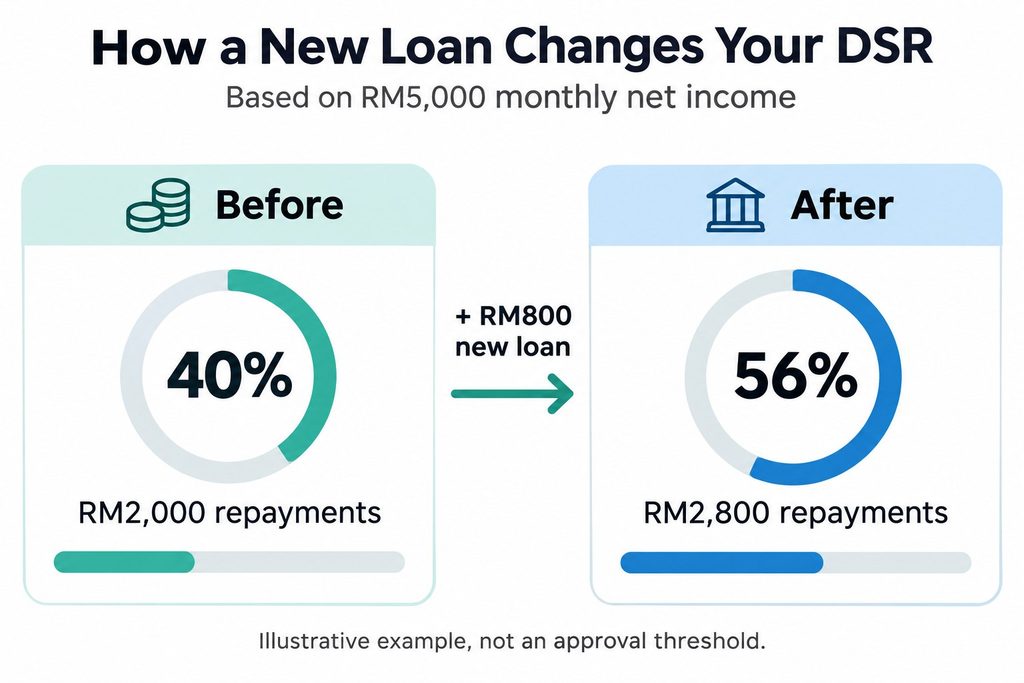
The additional RM800 commitment increases the borrower’s DSR from 40% to 56%.
A bank may reject the application because of affordability concerns rather than a personal loan blacklist.
This simplified example uses net income. Individual lenders may apply different DSR calculations and approval criteria.
Read More: What to Do After Your Loan Application Gets Rejected
How Long Does It Take to Rebuild Credit After a Personal Loan Blacklist?
Credit recovery can begin once overdue payments are addressed, but establishing a stronger repayment history takes time.
CCRIS displays repayment conduct over the most recent 12 months for reported credit facilities.
Settling arrears can improve your current repayment status in the subsequent reporting cycle. However, previous late payments remain visible within the reporting period.
Other information, including outstanding debts, legal proceedings and records held by private credit reporting agencies, may still affect borrowing eligibility.
Credit Recovery Timeline
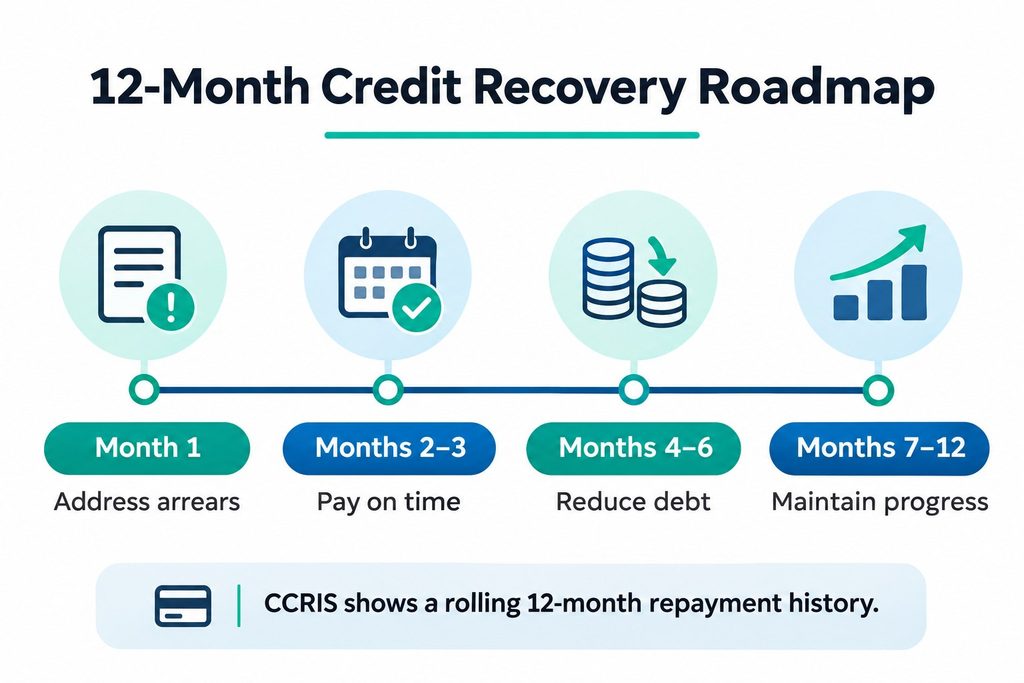
These are suggested recovery milestones, not guaranteed credit-score improvements or approval dates.
Does Your Credit Score Recover Automatically After 12 Months?
Not necessarily.
Although older missed payments leave the rolling CCRIS repayment history, other factors may continue affecting your financial profile.
These include outstanding debts, legal proceedings, lender-specific records and information maintained by private credit reporting agencies.
Private credit reporting agencies are subject to separate legal rules. Under Malaysia’s Credit Reporting Agencies Act 2010, default information generally cannot remain in a credit report more than two years after final settlement.
Twelve months of consistent repayments is a useful recovery milestone, not a guarantee of a particular credit score.
Can You Recover Your Credit Faster?
You cannot legitimately accelerate the passage of historical repayment months.
However, you can take immediate action to:
- Resolve outstanding arrears.
- Correct inaccurate information.
- Reduce unaffordable commitments.
- Prevent new missed payments.
- Monitor your reports regularly.
These actions strengthen your financial position without expensive credit-repair services.
When Should You Apply for Another Personal Loan?
Consider applying only when your repayment history has improved and you can comfortably afford additional commitments.
Before applying, confirm that:
- Outstanding arrears have been resolved or are being managed under an agreed arrangement.
- Credit reports contain no unresolved factual errors.
- Recent repayments have been consistent.
- Income is stable and properly documented.
- Existing debt commitments remain manageable.
If your finances remain unstable, postponing new borrowing may be safer.
For Malaysians planning to purchase a home, reviewing mortgage affordability before committing to another personal loan is particularly important. Additional monthly repayments can reduce your housing financing capacity.
Common Mistakes That Can Delay Credit Recovery
Applying for Several Loans After Rejection
Submitting multiple applications without addressing the original loan rejection reason is unlikely to help.
Ask your lender about the reasons for rejection. If a credit reporting agency’s report contributed to the decision, you have rights under Malaysia’s Credit Reporting Agencies Act 2010 to identify the agency and access the relevant information.
Paying Someone to Remove Accurate Credit Records
Avoid individuals promising guaranteed blacklist removal or immediate credit-score improvements.
Accurate repayment information cannot simply be deleted upon request, although applicable reporting and retention rules must be followed.
Ignoring Small Outstanding Balances
Even small overdue amounts can represent unresolved repayment obligations.
Review every reported account, including those you believe have already been settled.
Taking Expensive Loans to Repair Your Credit
A new loan is not automatically a credit-repair solution.
If repayments strain your budget, further missed payments can worsen your financial position.
Getting Back On Your Feet
Recovering from a personal loan blacklist in Malaysia starts with understanding your credit reports, resolving outstanding debts and maintaining consistent repayment habits.
Although your current credit status can improve after settling arrears, previous missed payments remain visible within the CCRIS reporting period. Lenders will also assess your affordability before approving new financing.
If your long-term goal is homeownership, WH Asia can help you understand your housing financing options through our mortgage consultant services. A professional mortgage assessment can help you review your borrowing position and prepare for a future housing loan application when your finances are ready.
Disclaimer: This article is for general information only and does not constitute personalised financial advice. Loan eligibility and repayment assistance depend on individual circumstances and lender requirements.
Sources and References
- Bank Negara Malaysia – CCRIS: Official guidance on credit information, repayment history and reporting.
- Bank Negara Malaysia – CCRIS FAQs: Guidance on reporting updates and dispute procedures.
- Bank Negara Malaysia – Repayment Assistance: Guidance on bank repayment assistance and AKPK support.
- Government of Malaysia – Financial Advisory Services by AKPK: Updated 13 March 2026.
- Ministry of Finance Malaysia – Credit Reporting Agencies: Published 20 October 2026.
- CTOS – Credit Reports. Information on CTOS reports and credit scores.
- PIDM – What Is Debt Service Ratio?. Published 19 July 2022.
Frequently Asked Questions About Rebuilding Credit After a Blacklist in Malaysia
Can I Get a Personal Loan If I Am Blacklisted in Malaysia?
Yes, but approval depends on your financial circumstances and the lender’s requirements. Outstanding arrears, poor repayment history or high monthly commitments can reduce your chances of approval.
How Do I Remove My Name From a Personal Loan Blacklist?
Check your CCRIS and CTOS reports and resolve outstanding debts. Request corrections for inaccurate information and maintain consistent repayments. Malaysia does not have a single official personal loan blacklist.
How Long Does CCRIS Take to Update After Loan Settlement?
CCRIS is updated monthly. Changes are generally reflected around the 10th of the following month, subject to public holidays. Historical missed payments remain visible within the rolling 12-month repayment record.
Will My Credit Score Improve After Paying Off a Personal Loan?
It can improve, but an increase is not guaranteed. Your remaining debts, repayment history and overall credit profile influence credit-score calculations.
Can AKPK Help Me Clear My Personal Loan Blacklist?
AKPK helps eligible borrowers manage and restructure debts through free financial counselling and debt-management services. It cannot guarantee the removal of accurate negative records or approval for future loans.
Can I Apply for a Housing Loan After Clearing My Personal Loan Debt?
Yes, provided you meet the lender’s requirements. Banks assess income, repayment history, existing commitments and affordability. Settling a personal loan does not automatically guarantee mortgage approval.