
Key Takeaways
- CCRIS shows your credit facilities, repayment history over the past 12 months and certain credit applications.
- CTOS provides broader credit information, including legal records, business interests and a credit score in eligible reports.
- Neither CTOS nor CCRIS blacklists borrowers or directly determines loan approval.
- Banks also assess your income, existing debt commitments and repayment affordability.
- You can check your CCRIS report for free through Bank Negara Malaysia’s eCCRIS platform.
When comparing CTOS vs CCRIS, the main difference is what they reveal about your financial history. CCRIS shows your borrowing and repayment records, while CTOS provides broader credit information. Malaysian banks may examine both before approving a loan.
However, having a clean credit report does not guarantee approval.
If your housing loan, car loan or personal loan has been rejected, understanding what banks actually check can help you identify potential issues before applying again.
What Are CTOS and CCRIS?
CTOS and CCRIS are credit reporting systems that help Malaysian lenders assess borrowers’ creditworthiness. However, they collect different types of information.
What Is CCRIS?
CCRIS stands for Central Credit Reference Information System, operated by Bank Negara Malaysia (BNM).
It records credit information submitted by participating financial institutions, including:
- Active housing, car and personal loans
- Credit card balances and credit limits
- Outstanding financing amounts
- Monthly repayment history over the past 12 months
- Pending and approved credit applications
- Accounts under special attention
For example, if you have a car loan and two credit cards, CCRIS can show your outstanding balances and whether repayments have been made on time.
CCRIS does not calculate a credit score or maintain a blacklist. It provides factual information that banks interpret when assessing loan applications.
What Is CTOS?
CTOS is a private credit reporting agency registered under Malaysia’s Credit Reporting Agencies Act 2010.
Depending on the report, CTOS may provide:
- Personal identification information
- Business ownership and directorship records
- Legal proceedings and bankruptcy information
- Trade references and reported payment issues
- CCRIS information
- A CTOS credit score
The CTOS Score ranges from 300 to 850, with higher scores generally indicating a stronger credit profile under CTOS’s scoring model.
However, this score is not an official BNM rating, and banks are not required to follow it when making lending decisions.
CTOS vs CCRIS: What Are the Core Differences?
The biggest difference between CTOS and CCRIS is the information they provide and where that information comes from.
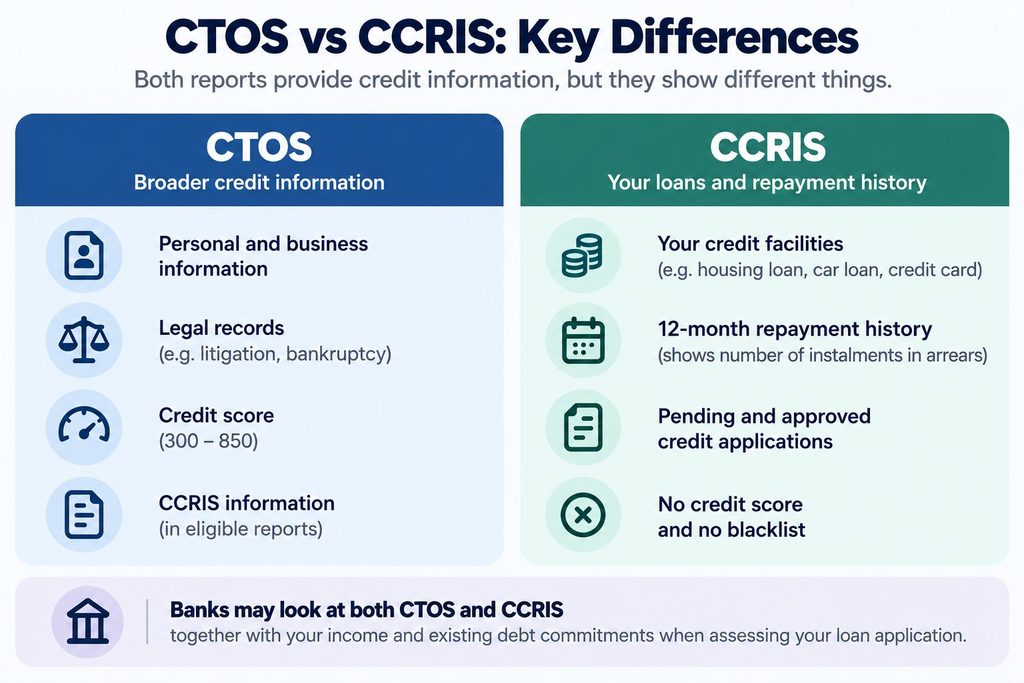
An important distinction is that certain CTOS reports already include CCRIS information, subject to the borrower’s consent.
For example, the MyCTOS Score Report includes CCRIS records, while the free MyCTOS Basic Report does not include a CTOS Score or CCRIS information.
Which matters more to banks?
Neither report is universally more important.
CCRIS helps lenders evaluate repayment behaviour, while CTOS may reveal additional credit risks. Their importance depends on the bank’s lending policies and the applicant’s financial circumstances.
How Do Banks Use Credit Reports When Assessing Loans?
Banks use CTOS, CCRIS and other supporting information to evaluate whether an applicant can manage additional borrowing.
Here are four major factors they may consider.
1. Repayment History
CCRIS shows monthly repayment conduct over the past 12 months.
Common repayment indicators show how many instalments are in arrears for a particular reporting month.
| Indicator | Meaning |
| 0 | No instalments in arrears |
| 1 | One instalment in arrears |
| 2 | Two instalments in arrears |
| 3 | Three instalments in arrears |
A series of zeros generally indicates consistent reported repayment conduct. These indicators are not credit scores.
Repeated late payments may raise concerns, although one missed instalment does not automatically result in loan rejection.
Banks may consider how recently the problem occurred and whether it has been resolved.
2. Existing Debt Commitments
Banks also assess how much of your income is already committed to debt repayments.
This is commonly measured using your debt service ratio (DSR).
Estimated DSR = (Total Monthly Debt Repayments ÷ Monthly Income Used for Assessment) × 100
Consider this example:
| Financial Details | Monthly Amount |
| Income used for assessment | RM5,000 |
| Car loan | RM800 |
| Personal loan | RM500 |
| Credit card commitment | RM200 |
| Proposed housing loan | RM1,200 |
| Total commitments | RM2,700 |
Your estimated DSR would be:
RM2,700 ÷ RM5,000 × 100 = 54%
Even with a clean CCRIS report, the bank may consider your existing commitments too high.
There is no universal DSR approval threshold across Malaysian banks. Lenders may calculate eligible income and monthly commitments differently.
This simplified example also excludes living expenses and other bank-specific assessment factors.
3. CTOS Score and Legal Information
Banks may consider your CTOS Score alongside CCRIS and other relevant credit information.
Potential concerns include:
- Bankruptcy records
- Relevant legal proceedings
- Unresolved payment obligations
- Business-related financial exposure
However, a legal record does not automatically prove wrongdoing or default.
Similarly, a high CTOS Score does not guarantee loan approval, as banks conduct their own credit assessments.
4. Income Stability
Banks must also establish whether you have sufficient and reliable income to repay a new loan.
Supporting documents may include salary slips, EPF statements, bank statements and income tax records.
For self-employed Malaysians, inconsistent earnings or insufficient income documentation can complicate loan applications even when credit reports are clean.
Can You Get Rejected With Clean CTOS and CCRIS Reports?
Yes. Banks can reject a loan application even when both credit reports are clean because credit history and borrowing affordability are different considerations.
Consider two hypothetical applicants:
| Assessment | Applicant A | Applicant B |
| Monthly income | RM5,000 | RM5,000 |
| Repayment history | Clean | Clean |
| Existing commitments | RM600 | RM2,000 |
| Proposed instalment | RM1,200 | RM1,200 |
| Estimated DSR | 36% | 64% |
Both applicants have clean repayment records.
However, Applicant B would spend a much larger proportion of monthly income servicing debts.
A lender may therefore consider Applicant B less able to afford additional financing.
These figures are illustrative and do not represent actual approval thresholds.
The takeaway: CCRIS and CTOS help banks understand your credit history, but your income and existing commitments help determine whether another loan is affordable.
How to Check Your CTOS and CCRIS Status Online
Checking your credit information before applying for a loan can help you identify errors or outstanding issues.
How to Check CCRIS Online
Bank Negara Malaysia provides free CCRIS reports through its official eCCRIS platform.
- Visit the Bank Negara Malaysia eCCRIS portal.
- Register for an account if you are a new user.
- Complete the required identity verification.
- Set up your login credentials and multi-factor authentication.
- Log in and generate your CCRIS report.
- Review your outstanding loans, repayment history and credit applications.
Eligible Malaysian individuals with MyKad and internet banking can register online. Other users can follow BNM’s alternative registration arrangements.
For eligible first-time online registration, BNM requires a refundable RM1 identity-verification transfer.
How to Check CTOS Online
You can obtain a CTOS report through CTOS’s official website.
The process involves registering an account, completing identity verification and selecting the appropriate report.
CTOS offers a free basic report, while more detailed products containing your CTOS Score and CCRIS information may require payment.
Check the current report features and charges before purchasing.
What If Your Credit Report Contains Errors?
For incorrect CCRIS information, contact the financial institution responsible for reporting the account.
For incorrect CTOS information, submit a dispute to CTOS with supporting evidence. CTOS may need to verify the details with the original source before making corrections.
Malaysia’s Credit Reporting Agencies Act 2010 provides consumers with rights relating to access and correction of inaccurate credit information.
How Long Does CCRIS Take to Update After Settlement?
According to Bank Negara Malaysia, participating financial institutions should update settled loan information by their next reporting date, no later than the 10th of the following month.
However, settling an overdue payment does not immediately erase your previous repayment history.
For example:
- Month 1: Your loan shows two instalments in arrears.
- Month 2: You settle the overdue amount.
- Next reporting cycle: Your current account status may reflect the settlement.
- Following months: The earlier late-payment record remains visible while it falls within the rolling 12-month period.
This means your account can be up to date while older late-payment indicators remain visible.
Also, the 12-month CCRIS repayment-history window does not mean every CTOS legal or trade-reference record automatically disappears after one year.
What Should You Do If Your Loan Was Rejected?
If your bank loan was rejected, identify the likely reason before submitting another application.
1. Ask the Bank for Clarification
Contact the bank to understand whether the rejection relates to repayment history, affordability, income documentation or another issue.
Banks may not disclose their complete internal assessment criteria, but clarification can help you determine your next step.
2. Review Your Credit Reports
Check your CTOS and CCRIS reports for:
- Outstanding arrears
- Incorrect loan balances
- Unfamiliar credit facilities
- Unresolved legal records
- Information that has not been updated after settlement
Report inaccuracies to the responsible institution or credit reporting agency.
3. Address Outstanding Commitments
If you have overdue payments, contact your lender to discuss repayment arrangements.
Where your existing debts are becoming difficult to manage, AKPK offers financial counselling and debt management assistance.
4. Reassess Your Loan Affordability
Before applying again, consider whether you should:
- Reduce existing monthly commitments
- Apply for a smaller loan amount
- Increase your property down payment
- Strengthen your income documentation
- Wait until recent arrears have been regularised and updated
Different banks have different lending requirements, but applying repeatedly without addressing the underlying issue may not improve your chances.
Should You Improve CTOS or CCRIS First?
The right priority depends on the problem affecting your application.
| Your Situation | Recommended Action |
| Recent missed repayments | Resolve arrears and maintain timely payments |
| Incorrect CCRIS information | Contact the reporting bank |
| Incorrect CTOS legal record | Submit a dispute with supporting documents |
| High debt commitments | Reduce debt and reassess affordability |
| Clean reports but rejected loan | Review income, DSR and bank requirements |
| Difficulty servicing debts | Seek AKPK financial counselling |
Avoid focusing exclusively on increasing your CTOS Score.
For example, improving an already strong score may not help much if your actual problem is insufficient income or excessive monthly commitments.
Addressing the underlying issue is more useful than chasing a particular credit score.
Conclusion: Understand Your Credit Profile Before Applying
Understanding CTOS vs CCRIS helps you identify what Malaysian banks may see when assessing your loan application. While both reports provide useful credit information, approval also depends on your income, affordability and the lender’s requirements.
If your financing application has been rejected, WH Asia offers loan and mortgage consultant services to help review your financial profile and explore suitable financing options. Prepare your latest credit reports, income documents and existing loan details before seeking advice.
Disclaimer: This article is for general financial education only and does not constitute personalised financial or lending advice. Loan eligibility and approval depend on each lender’s requirements and your individual circumstances.
Sources & References
- Bank Negara Malaysia – CCRIS. Official guidance on credit reporting, repayment history and credit assessment.
- Bank Negara Malaysia – eCCRIS Portal. Official platform for CCRIS registration and report access.
- Bank Negara Malaysia – eCCRIS Registration is Now Digital (2022).
- Ministry of Finance Malaysia – Credit Reporting Agencies Act 2010 (Act 710).
- Ministry of Finance Malaysia – Credit Reporting Agency FAQs.
- CTOS – Credit Report and Score.
- CTOS – Correcting Credit Report Errors.
Frequently Asked Questions About CTOS vs CCRIS
Is CTOS Worse Than CCRIS?
No. CTOS and CCRIS provide different credit information. Neither is inherently worse, and banks may consider both when assessing a loan application.
Can I Get a Loan With a Bad CTOS Record?
Possibly. Approval depends on the information involved, your income, repayment capacity and the lender’s requirements. An unfavourable record can make approval more difficult but does not guarantee rejection.
Does CCRIS Have a Credit Score?
No. CCRIS records credit facilities and repayment information without assigning a numerical consumer credit score. CTOS provides a separate score in eligible report products.
Will My CCRIS Become Clean After 12 Months?
Previous late-payment indicators eventually fall outside the rolling 12-month repayment history. However, outstanding debts do not automatically disappear, and other credit-reporting information may remain.
Does Checking My Own CTOS or CCRIS Affect My Credit Score?
Checking your own report is not the same as applying for financing. Reviewing your credit information does not create a new loan application or reduce your CTOS Score.
Can Banks See My Previous Loan Rejections?
CCRIS does not display rejected loan applications as rejection records. However, pending and approved applications can appear, and banks may have relevant information from other lawful sources.